

Keeping the Peace of the Realm
Constitutions are about power, and who wields it.
Each constitution reflects not only the political ideal that the Founders want, but also the reality that it has come from. The Commonwealth of Australia Constitution Act, written in 1901 is no different. A federal construct was chosen, reflecting the reality of a continent occupied by separate and self-governing States. A federal structure was a deliberate choice. As A V Dicey explains in the Introduction to the Study of the Law of the Constitution (8th edition, Macmillan, 1915, p. 167), a ‘federal government means weak government.’
It is perhaps the single most important aspect of how power is divided in Australia. As Professor Anne Twomey notes:
'Federation did not transform Australia into an independent sovereign nation. It merely consolidated six colonies into one federated larger colony.' – Anne Twomey, The Chameleon Crown: The Queen and Her Australian Governors (Federation Press, 2006, p. 18)
So how does a weak, federal system maintain its laws? Australia’s intended solution was for the states to do the heavy lifting and for the federal military to intervene when required. How? Well, the Constitution says in section 61:
The executive power of the Commonwealth is vested in the Queen and is exerciseable by the Governor-General as the Queen's representative, and extends to the execution and maintenance of this Constitution, and of the laws of the Commonwealth.
Understanding what executive power means and how it works was the basis for my PhD at the University of Adelaide, and which was published as Keeping the Peace of the Realm (LexisNexis, 2021). I found there had been 36 times that defence had been contemplated to be called out against Australian citizens, either at the request of a state or at the initiative of the Commonwealth. The intent of my Fellowship at the National Library of Australia in 2025 was to go beyond the text and see what the Executive (those members of Parliament in Cabinetmaking decisions) thought when they were trying to enforce federal law, or the members of State Executives when making a request. To do so, I focused purely on the personal papers or oral history transcripts in the Special Collections Reading Room at the National Library.

Dr Samuel White, 2025 National Library of Australia Fellow
Dr Samuel White, 2025 National Library of Australia Fellow
Over the course of my fellowship, I discovered that the events I expected to generate the most debate and moral uncertainty were ultimately non-issues for those making the decisions. There were also call-outs that had been contemplated or requested but never had any official documentation. There was ongoing frustration by members of the federal government that there was no other option in our system between relying upon state police or federal military. The Commonwealth was either powerless or forced to take drastic measures.
In the Papers of William Hughes, the anger over an egg being thrown at him sparks the slow, winding creation of the Australian Federal Police. In the Papers of Andrew Fisher, Federal Labor reticence to involve themselves in breaking strikes leads to the ultimate development of federal jurisdictions of industrial arbitration. The threat of Communism (and not just in Menzies’ personal papers, but also the Papers of Joseph A. Lyons highlights the weakness of a federal system – is a bomb going off a state problem or federal? It is a problem that is ultimately resolved by the High Court in 1951 and 2007 but for a long time, elected representatives thought they were powerless outside of the Australian Capital Territory.
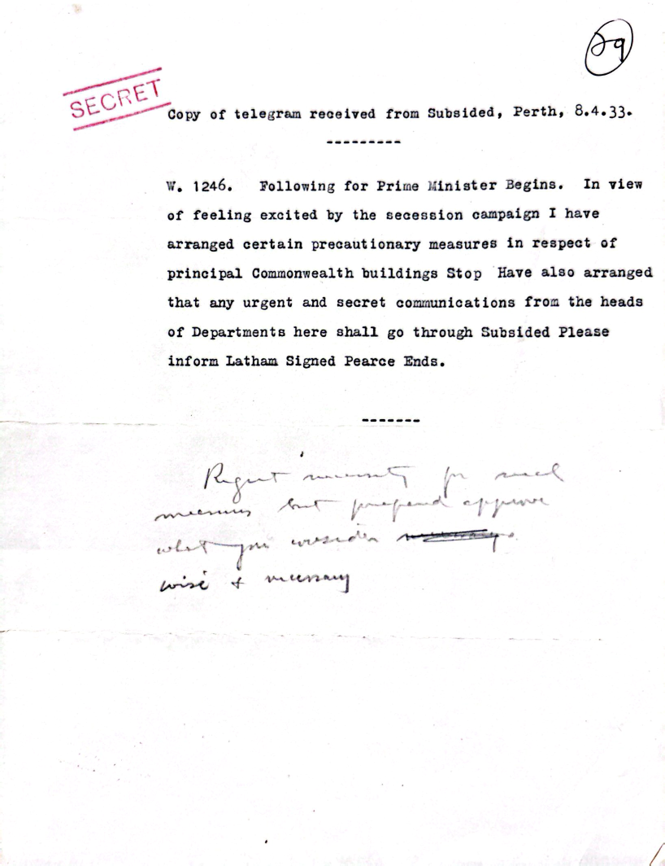
Papers of Joseph Aloysius Lyons, 1924 - 1939 [manuscript], National Library of Australia, nla.cat-vn1109693
Papers of Joseph Aloysius Lyons, 1924 - 1939 [manuscript], National Library of Australia, nla.cat-vn1109693
Perhaps the most explicit and damning documents found though were in relation to the Order-in-Council (a formal document tasking the Governor-General) around deploying the Pacific Island Regiment against Papuans squatting on the Gazelle Peninsular. They were a ‘native troop’ regiment with white officers. A colonial concept for a colonial endeavour and it showed. It is worth the history lesson to remember that Papua New Guinea was under UN Administration, the responsibility of Australia at the time. When land-right activists were resisting Administration Law, they were resisting Australian law. Whilst military planners were caution of international reputations and possible breaches of international law, the Prime Minister (in his own words) was concerned with the:
…thought of a lot of white people in Rabaul and other countries like that, suddenly being involved with spear-carrying, axe-wielding people who walked in on them and were just mad.
Although the Governor-General initially refused to sign the document, he later did so following Cabinet direction. What was the legal basis for this proactive action? The threat to the Commonwealth was minimal – some squatters on a peninsular on an island in a colonial territory. There was no request from the Territory – the personal Papers of Sir David Hay show that. It was a fear that Papuans would not shoot their own, and that the police cost too much to maintain in the tropics. The Constitution was re-interpreted. For the first time ever, a potential threat to the Commonwealth was enough to create federal jurisdiction. So much for that weak government idea.
The law, as it currently exists reflects the new dynamic. The Defence Act 1903 (Cth) has always regulated how and when the Australian Defence Force can be called out. There are circumstances where a State cannot deal with the problem and ask for help. That is appropriate. Yet since 1970 and the lack of faith in the Pacific Island Regiment, the Commonwealth has relied upon a fear of being unable to respond to allow for proactive (so-called contingent) call-outs. It makes sense as the Commonwealth should be able to protect itself and the Constitution is not so impotent a document to make a federal system entirely reliant upon a State. Yet should such extraordinary power continue to rest solely in ministerial prerogative, shaped in the shadows of crisis or is it time to draw it into the light — defined, constrained and justified by law rather than left to the instincts of those who wield it?
More to explore


Dr Samuel White
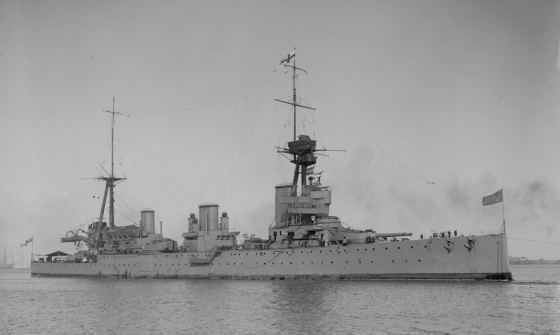
Australian battlecruiser HMAS Australia in 1914, Alan C. Green, State Library Victoria