

12 years in: Writing for the Future Library (2014-2114)
12 years into the century-long literary artwork Future Library, created by Scottish artist Katie Paterson, producer and chair of the Future Library Trust Anne Beate Hovind shares the twelfth chapter of a project that will one day comprise one hundred.
Rooted in Oslo, Norway, the work grows, quite literally, alongside a forest planted in Nordmarka in 2014, whose trees will become the paper on which these sealed manuscripts will finally be printed in 2114.
Over the years, writers including Margaret Atwood, David Mitchell, Sjón, Elif Shafak, Han Kang, Karl Ove Knausgård, Ocean Vuong, Tsitsi Dangarembga, Judith Schalansky and Valeria Luiselli have entrusted their unseen texts to the project.
This June, Tommy Orange and Amitav Ghosh will join them, handing over their manuscripts in a ceremony in Oslo. Written for readers who will live a century from now, the Future Library unfolds slowly and tenderly across time. It invites us to consider authorship, trust, and the long arc of cross-generational responsibility, as well as the climate and nature crises shaping our shared future. It asks what it means to write for an audience we will never meet, and how literature might carry care, imagination and solidarity across generations.
12 years in: Writing for the Future Library (2014-2114)
Jo Ritale:
Good evening, everyone. My name is Jo Ritale and I'm the Assistant Director General of Collections here at the National Library. It is my pleasure to welcome you this evening. Tonight we're diving into something truly special, a project that stretches our imaginations far beyond our own lifetimes. Future Library is one of those rare ideas that makes you pause, breathe, and think about time differently.
To begin, I want to acknowledge the traditional owners and custodians of this land, the Ngunnawal people. I acknowledge their ongoing connection to the land and pay my respects to their Elders past and present and through them to all First Nations people here tonight or listening online. As a meeting place, Canberra has been the cradle of numerous stories, a country of creativity. The Ngunnawal and First Nations peoples across Australia have been keepers and sharers of stories and histories for millennia and this is a legacy the Library continues to follow today.
I also want to acknowledge our collaboration with the Royal Norwegian Embassy with whom we are partnering to deliver tonight's programme. We are joined tonight by Mr Erik Svedahl, Deputy Head of Mission and many esteemed representatives and we thank you for introducing us to this remarkable project and your support in sharing it with our audience.
Future Library began in 2014 with a forest planted in Nordmarka just outside Oslo. Those trees are growing right now and in 2114 they'll become the paper for a hundred manuscripts that no one alive today bar the authors have ever read. 12 years in, we're still at the very beginning of this century long artwork and therein lies the magic.
We're incredibly fortunate to have with us Anne Beate Hovind, the producer and creator of Future Library, the person who has steered this project from a bold idea into a living, breathing cultural landmark. Anne Beate works at the intersection of art, architecture, and public space and she has a real gift for creating projects that unfold slowly and meaningfully over time.
In conversation with Anne is Kathryn Favelle, who many of you will know from her long career here at the Library. Kathryn has spent decades talking with writers, readers, and thinkers, making her the perfect person to help us explore the many wondrous layers of this project.
Over the next hour, we'll talk about what it means to write for readers who won't be born for another century. We'll touch on trust, stewardship, and imagination, as well as the climate crisis that makes this project feel even more urgent. And of course, we'll hear about the extraordinary writers who've contributed so far. Margaret Atwood, David Mitchell, Han Kang, Ocean Vuong, Elif Shafak to name just a few. So let's settle in, let our minds stretch a little and enjoy this chance to think about literature, not just as something we consume, but something we can pass forward.
Before we begin, please welcome Erik Svedahl to say a few words on behalf of the Royal Norwegian Embassy.
Erik Svedahl:
Thank you very much. Dear guests, ladies and gentlemen, allow me also to acknowledge the traditional custodians of the land on which we meet, the Ngunnawal people, and pay my respects to Elders past, present, and emerging.
It is a great pleasure for me to represent the Royal Norwegian Embassy tonight at the National Library. I'm very excited to learn more about one of the most remarkable literary projects of our time, the Future Library.
Norway and Australia may be geographically distant, but we have a lot in common. In both our countries, literature is shaped by landscape, by vast spaces, by distance, and by a close relationship between people and nature. In Norway, writers have long explored life in remote communities and dramatic natural surroundings. In Australia, literature reflects equally powerful encounters with distance, climate, and place. In both traditions, storytelling becomes a way of understanding who we are and where we belong.
Australia's greatest short story writer, Henry Lawson, captured the hardship, humour, and humanity of life in the bush with a clarity that still resonates today. Less widely known perhaps is that Lawson had Norwegian roots. His father, Niels Larsen, was a Norwegian sailor who arrived in Melbourne in 1855 to join the gold rush. In 1866, he married Louisa Albury, an Australian poet, writer, publisher, and feminist and Henry, whose surname was Anglicised to Lawson when the parents registered the birth, was the eldest of their 5 children. This is a reminder that even the most national of literatures often contain threads that connect us across continents.
The Future Library Project is a powerful example of connections across continents, cultures, and generations. On behalf of the embassy, I would like to take this opportunity to thank Anne Beate Hovind, the chair of the Future Library Trust for having come all this way from Norway to share with us the concept and vision of the Future Library. She has been invited to be a guest at the Sydney Writers Festival and graciously accepted the Embassy invitation to come to Canberra first to talk about this amazing project.
I would also like to thank Jo and the National Library team for their enthusiasm and wonderful efforts in organising tonight's event. Thank you very much and enjoy the evening.
Margaret Atwood in video:
In the forest, there is a city and in the city there is a library, the Future Library. The Future Library is an artwork that is going to unfold over a hundred years where each year from 2014, a writer is commissioned to write any piece, nonfiction, fiction, poetry in any number of words and it will not be read until 2114 when the books are printed from the pulp of the trees being grown in the forest. These trees that in time will be used to print these a hundred texts. What a wild idea you had here, Katie Paterson.
Katie Paterson in video:
When you plant trees, you're aware that it's something that's going to outlive you and this art piece is really about an unborn generation and trying to make a place for them. Besides Margaret Atwood, for the past 10 years, you and many other international and celebrated writers agreed to participate in my wild idea. Why did you want to do this, Margaret, as the first writer of this art project?
Margaret Atwood in video:
This is a letter to the future. We assume that people will still be around, that they will be able to read, that they will still be interested in reading, that there will still be a library. We don't know how the world will be with the climate and humankind, this is a project that is immersed in hope and a cosmic sense of time. Think of this as cultural storage for the future.
Katie Paterson in video:
That books are trees and libraries are forests.
Margaret Atwood in video:
And that this future could be beautiful.
Kathryn Favelle:
Good evening and isn't that a beautiful way to begin our introduction to the Future Library Project? I'm Kathryn Favelle and welcome Anne Beate to Canberra and to the National Library of Australia.
Anne Beate Hovind:
Thank you.
Kathryn Favelle:
I love in this animation, which I encourage you to watch again because I have watched it many times now. Both Katie Paterson, the artist, and Margaret Atwood referred to the project as 'a wild idea.' And 12 years in, I think it's still a wild idea. I may have described it as a little bit bonkers to some people as I've been introducing them to it, but could you take us back to the very beginning of the project and tell us how it was conceived and how you managed to get people to say yes to it?
Anne Beate Hovind:
It's a long story and I can't tell all the secrets, right?
Kathryn Favelle:
Well uou can. It's a quiet space. We won't tell.
Anne Beate Hovind:
So I work in the construction business, believe it or not. So I've been working with the waterfront development in Oslo for many years and as I work for the property developers and part of the infrastructure that we built in a new transformation of a city in the waterfront are the public spaces and with public spaces there comes art. And in Norway, we tend to choose art [unclear]. So we didn't want these [unclear] dropping down around in that borderfront development. We wanted something extraordinary. And I'm mentioning this because to commission [unclear], it's a funny thing because it's a lot of [unclear] in Norway, but I think there are [unclear] in all countries. It's the default choice when it comes to art in public space.
Kathryn Favelle:
So that's sculptures.
Anne Beate Hovind:
Drop sculptures we call them bloop. They come like that. So we wanted something extraordinary and that is much more difficult. That's not the easy way. So we were very much inspired by the Opera roof in Norway. In Oslo, if you've seen that, it's a walkable roof. So we wanted the artist, the artist brief was, could you please create something that is inspired by that roof because it's like a landscape. You have to slow down. It's non-commercial, it's public and open for everyone. And so that immersive kind of feeling is what we wanted the artists to propose.
That's risky to do because my board are the property developers and when you are asking artists to work so freely, you never know what you get. And my job was to make it happen. So of course, when Katie was asked to come to Oslo, she was there. She did a lot of research and she called me after. And then she went back to Berlin. She lived in Berlin, like all artists did back then. And she called me after a week and she said, "I think I have a perfect idea for the waterfront development, but I need to stay in a forest first because I never really lived in a forest." I come from the deep forest myself, I grew up on a farm, I know all about that. So I took her to a family cabin and placed her there for a week and when she literally came out of that forest, she said, "No, I'm going to tell you." And she said, "It's going to last for a hundred years." And I said, "No, no, no, no, no. I'm not going to do that."
And remember property developers, they're very good in economy, risk management and all that. And I knew if I had told them about the hundred years they would have asked me to do a risk assessment and nothing would have happened. So that's a learning point. Don't do risk assessments or think about risk in a different way. And I really mean this innovation, risks is a totally different thing because the risk assessment in the construction business is to close all gaps, right? But when you work with innovation and artists, risk assessment is really about daring to keep the doors open as long as possible. I've learned so much from working with art, so now you've got that one.
So the hundred years, I couldn't even think about it. And then she asked, she said, "We're going to grow a forest with thousand trees." If you look in the waterfront development, where can you buy land to grow a forest for an art project? But what Future Library and Katie of course taught me was that to think out of space and out of time. She was totally out of the concept. So when she proposed a forest growing, I had to stretch myself out of that waterfront development specific space because surrounding Oslo is a forest that the politicians decided to buy more than a hundred years ago for us that lives there and beyond that there is a privately owned big forest. So I was quite amazed by this publicly owned forest because it's ours and I felt like it's very much aligned with the work itself that is ours. It belongs to us.
So that's when I dare to go to that director in the municipality and I had asked for a meeting and he knew I was working in the waterfront development so he was complaining about a lot of things. He was not very happy and I was quiet. And then he said, "Didn't you ask for this meeting?" "Yes." And said, "What do you want?" "Okay, I need a forest." And he said after being quiet for a while, he said, "Why not?" We need more 'why not' people. That's when things happen. So he actually gave us that forest there and then and that's when I started believing in this work to happen.
Kathryn Favelle:
So can I ask what happened when you finally confessed to the board that you were talking about a hundred year project?
Anne Beate Hovind:
I'm not sure if I've done it yet, to be honest. I've never actually discussed that matter. It makes sense 100 years, but I don't know how to get my head around it still. I've just decided I'll just go for it. And some things you cannot think too much. You just have to go for it. You have to dare to take that risk.
Kathryn Favelle:
Because there are a lot of 'no points' in this project. There's the forest of a thousand trees, there's a room, the silent room that's been built in a library. The project is creating a collection of works by a hundred writers over a hundred years. At some point in 2114, the forest will be cut down and there will be a book made from the paper from the trees. And on top of all of that, you've now got an agreement with the city of Oslo to look after this project for a hundred years.
Anne Beate Hovind:
Don't tell them.
Kathryn Favelle:
Have there been points in the last 10 to 12 years where you've thought 'this is not going to happen'? Or once you got that initial buy-in for the land for the forest, did everything feel possible?
Anne Beate Hovind:
I often think, it's becoming a very big responsibility because a lot of people around the world resonate with the work. We could never dream that this could happen. So for me personally, it's a growing responsibility and I must say it's heavy also. So it makes me going, but it's also worrying because of course there's lots of things that can happen. I mean, there's so much uncertainty in the world. We can just think of what has happened the last 3 years around us. And so what really, this is of course very personal, but for me personally, I think despite all the instability, this to just do, keep on doing a work as a ritual creates stability, even though there's so much uncertainty. So it's become a life changing project to be honest. So I cannot give up. It's too much to carry.
Kathryn Favelle:
And at some point you will have to give it up and pass it on.
Anne Beate Hovind:
I'll die. I'll die.
Kathryn Favelle:
Pass it on to the next person.
Anne Beate Hovind:
But Katie doesn't want me to die because every time we talk about that, she say, "No, no, no, no."
Kathryn Favelle:
Maybe she'll come up with a solution for you.
Anne Beate Hovind:
Maybe we will.
Kathryn Favelle:
Okay. Keep on going. One of the things that Katie has said about the project and if you haven't discovered Katie Paterson's work, please go online and have a look. She has done some extraordinary things. She's recorded the sound of a glacier breaking off, ice breaking off a glacier for people to phone in and listen to. She's mapped the dying stars. She really approaches the world in a unique way, I think. And the projects do sound like wild ideas to begin with and then she makes them happen.
She's described to the core of Future Library as time and longevity, but also hope and rituals. So I wonder if you can take us through a year in the project and talk to us about some of the rituals that have grown up as the project has developed.
Anne Beate Hovind:
Yeah, that is the most important ritual. So [unclear], I'm getting older, that's part of it too. So it's part of the concept. So Kate is a conceptual artist. So of course there are different elements that make this work and one of the parts is the ritual itself, which is the handing over the manuscript. And so the contract with the authors is that they have to come to Oslo and they have to walk in the footsteps of the previous authors into the forest where this image is that showed behind me here and that's in the forest, that's where the handing over happens.
Being Norwegian, coming from the forest, I thought that this was not important to the authors, honestly. So during COVID, I don't know if you remember that we turned red and green and all these kind of things were locking down and Karl Ove Knausgård, he's a Norwegian author and he was the one that was supposed to come for the handover that spring and he lives in London and then suddenly London turned red and then Oslo turned red and we couldn't travel and we couldn't go and we had made a plan B, which we all did, digital plan B.
And I wrote to Karl Ove Knausgård, I said, "I'm sorry COVID is making it impossible. We'll now do the plan B, the digital." And he had agreed and you know, it's not a big administration so it's a heavy load of work for a few of us to make this happen. And then 3 days before it was going to happen and I was going to go to the forest before him, he wrote me and said, "Dear Anne Beate I have to walk myself." At first I panicked, but he taught me, first of all, he also taught me for the authors, it's the process of walking, the ritual itself, which it was important. To be in that forest and being part of that shared experience and feeling of having something in common, which was important. So he taught me, he wrote back and he said, "We have to take life as it comes."
So that's why we are totally relaxed now if authors are delayed because they have to come. That's much more important. But coming from a forest, I always think every time I take people to the forest, I'm thinking, "Oh, it's just another forest" because it is really just another forest, but it's become a sacred place actually.
Kathryn Favelle:
It's become imbued with a whole lot of meaning and community. How are the authors chosen, selected, and how did you manage to have Margaret Atwood as your first author? She seems now, looking back, it's like who else would you actually ask, someone who'd grown up in the Canadian forest who understood words and imagination and time and all the touch points that this project offers?
Anne Beate Hovind:
First of all, there's a trust. So the organisation with the trust is set up. I did that in 2014 because that's like you need to have that kind of a body to look after the work for a hundred years and that's at least, in the future it will be independent of both the artists and me. So we have a board and the trustees, we select an author every year and that's a very slow process. So we have only 2 criteria, that's imagination and time, but that's for all authors, so that makes direction.
But we sit down and we had, but the first year we had a long list and we thought we could start on the top and then every year we can take the next one as if it's a linear process. It's not linear. It's extremely organic. And so we understood already after what first year that when we wanted to select a new one, it's like everything needs to be reconfigurated in a way. It's a new decision every time, but still it's very slow since it's one a year.
Okay, Margaret Atwood, that in 2014 we had no idea how this was going to unfold. Well, there was an idea, but we had no proof that it was going to happen. So I don't really remember why we dare to ask her. And this was before 'The Handmaid's Tale'. Remember after 'The Handmaid's Tale', she's become a rockstar with bodyguards. She's 88 or something. But what was fantastic is that it took her, I think, 2 days to respond. So she just got it immediately. She just said yes, that's a gut feeling.
And what was really great to have her on board was that from the beginning is that she, for instance, she wrote me an email. She said, "I want this to be Periscoped." I said, "What? Periscoped?" And then she said, "On South by Southwest," which is a big conference in Austin, tech conference, they had launched this application, I don't know if you used that word that time, that could real time stream events. It's called Periscope. Today we have lots of apps like that, but she loves tech so she knew what had happened on that. So that made a problem for me. So I had to find out what is Periscope and then stream the first event. But because of her, we got the idea to stream every year so it's accessible for everyone around the world to watch.
Kathryn Favelle:
And you're streaming from a forest, which adds another degree of difficulty to the streaming process as well.
Anne Beate Hovind:
Yes, but I managed. And also she has a lot of meaning about the forest because her parents were scientists and she grew up in the forest. So she was also very concerned that, "don't introduce any new species." So we listened to her. She was a very strong advice on a lot of things.
And the first years, I think the first year, I think most of the journalists asking about this project were asking us, "will there be books in the hundred years?" As if the digital books will take over. No journalists ask that question anymore. Margaret Edwards said from the very beginning, it's a hopeful project, that the core of the work is hope. So she got it from the very beginning, being very dystopian, famous for being that. So she's not actually [unclear]. And she's taught me something very important because she talks about practical utopias. She says, "Visions are too far. What we need today are practical utopias because they are within reach." And I think this is a driving force for me too that we have to dream or imagine and create tomorrow. We can't wait. Let's create practical utopias
Kathryn Favelle:
That links into something else I've heard you say, which is that we need to learn to be great ancestors. How has this project shaped your thinking about what it is that we're leaving the future generations?
Anne Beate Hovind:
Yeah. Then I can become quite emotional. Now I grew up on a farm. I have the name of the farm, H-O-V-I-N-D. You're from Australia, but this is a Viking farm. HOV is a place and the name of the farm is that name and the name of the hill. I'm 14 generations on that farm. So I, I had totally, when my father died very young, I was entitled to have the farm, but I decided not to become a farmer. I left and got an education and all that. And I kind of totally forgot about, or I thought everything I had learned on the farm with forestry and all that, because I worked a lot on the farm, it was useless all that knowledge. But through this work, I've learned it's crucial.
And I think, I understand that there is only 2 generations that have left that long-term thinking. So we are trapped in the short-termism and the long-termism entitles cross-generational projects. And I think it's so important now to take that back because it's urgent, we need to think long-term to deal with the problems we're in. So I think despite everything, what's happening and the speed of everything today, we need to invest in the future that are beyond my life or your life, but really requires generations to fulfil them. So it's called so- called cathedral thinking, for instance.
Kathryn Favelle:
So as you've been talking about Future Library around the world and this year in particular, I know you've been doing a lot of travel, have you got a sense that people are starting to understand the need to go back to long-term thinking? Or do you feel like you're, there's still a bit of a voice in the wilderness. Maybe not the wilderness, but your alone voice and waiting for people to catch up with this idea.
Anne Beate Hovind:
Yeah, but I think if there is any criticism about the work, really not a lot. At least people haven't told me. It's really about this, "ell, why should we care for work that is the text?" They're provoked by the fact that they cannot read the texts. But it's not about instant gratification. It's about actually waiting, waiting impatient and leaving something for the next generation.
I think my experience is that most people today are longing for that. I think that's why it resonates with people in all over the world despite, across generations, across borders, across ethnicities, religions. It really proves that there is something we have in common, that we share, that is about being a human being. And I think a lot of people are worried. And to have that direction that this triggers is not the answer, but it opens up for these kind of questions and reflections.
Kathryn Favelle:
Is that one of the surprises of the project for you? That something that started out being for a city in Norway has actually become a global connector?
Anne Beate Hovind:
Yeah. We couldn't see that, no.
Kathryn Favelle:
Yeah.
Anne Beate Hovind:
And it's not a linear like [unclear]. I'm going to create a work. No, no, it doesn't work like that. We had no idea. I'm as surprised every day as everyone else and I feel so humbled and grateful, but also responsible.
Kathryn Favelle:
When you first encounter the project, at least in my experience of it, you focus on the end point that there will be a hundred writers and a hundred years and eventually there will be a book. But something Katie Paterson said in a TED Talk really resonated with me when she said, "Where the artwork takes place is in the imagination of the visitors." And the visitors have started coming since day one. When you think about the project, are you focused on future libraries endpoint or are you focusing on the experience that's happening now, 2 years from now, maybe 5 years from now, yesterday?
Anne Beate Hovind:
I'm worried. So I not often think about the endpoint. So I'm really happy I'm in the process. I can imagine the endpoint because I think I will have at least great grandchildren there and I can imagine them as I can read all letters that I had a hundred years old that I have from my great-grandfather to his son that I've accidentally found is such a gift. And then I can imagine then my great-grandchildren being present when all this happens. I think they'll be proud maybe. "Oh, my great-grandmother was part of this." That's easy, but I'm one of the worried ones.
So I think for me the comfort and the beauty is in the process. And so that's what's the driving force to make this happen every year. I honestly think only one year at a time because I have all the worries, practicalities too. But I really think this is what makes me going to have this to one step at a time, one break at a time. It's a way to deal with it, right? Also with uncertainty.
Kathryn Favelle:
Should we talk a little bit about the secret room? What you're seeing in the images behind us are beautiful moments in the life of Future Library. And you've probably already seen the incredibly gorgeous room that's now in the main public library in Oslo. Do you want to tell us a bit more about that and how it came to be and why it's there?
Anne Beate Hovind:
Yeah. We had to have a place to have the texts, but that was part of Katie's idea to have this kind of silent room. And it's a longer story how we got it right there. It's also about knowledge about construction business because I work in the construction business. I had made a contract with the architects on this library, believe it or not. And I knew that on the fifth floor there was already programmed a silent room. And I thought, oh, it's very hard to get these kind of spaces.
So I asked the construction business in a construction project, "Why can't we have this space? We will make the interior and it won't cost you anything. I'll pay for it as long as we get," And it will still be a silent room. That's clever. So don't tell them.
And so yeah, that is on the fifth floor and the interior is made out of the wood that we cut, that was ready to be cut before we planted 1000 new trees. And it's carefully designed by the artists and the architects of the library and to fit those hundred boxes and these hundred rings. And it looks very big but it's not so big, but it's a beautiful space where youngsters like to hang out. That said too. But also I was there just before I went here and it's crazy amazing how many people visit the room from all over the world.
But the library itself is also fantastic. It's the most diverse public space safe space in Oslo and it's become, I'm so proud of that public library and it's so generous. It's the images you see too. It's fantastic public space.
Kathryn Favelle:
One to add to our library tourism bucket lists, I think
Anne Beate Hovind:
Yeah. It's really, library tourism.
Kathryn Favelle:
When the writers hand over their work to you, are you ever tempted to take a look?
Anne Beate Hovind:
No comments, no. Not really, but you just saw Han Kang from Korea. She got the Nobel Literature Prize 2 years ago, but she was ours 7 years ago and she dragged that white clothes. She performed. It was fantastic and very emotional.
The thing is that some authors are very organised, like Margaret Atwood and she has printed her text, 2 copies, 2e have 2 copies, and everything is ready. But that doesn't come for all of them. And so Han Kang, she hadn't printed her manuscript and we actually stayed in a cabin one night. There's a beautiful cabin very close to the forest and we stayed there one night and there's no shower or no electricity, so it's very simple. So she had needed a shower and so I have a printer in my basement. So that manuscript is actually printed in my basement while she took a shower, don't tell her room, but it's in South Korean. So I actually saw it, but I couldn't read a word.
Kathryn Favelle:
So there's no requirement on them to write in a particular language.
Anne Beate Hovind:
No, no.
Kathryn Favelle:
And that has opened up the possibility of the Future Library also playing a role in language preservation. Sean, the Icelandic poet has spoken about that in relation to his language.
I know that you have a printing press as part of the collection that is the Future Library to be able to train people how to print the books when the time comes. Have you thought about having language-based dictionaries so that if there is a need to translate or to recover a language, some of those materials are available for those who are running the project in the future.
Anne Beate Hovind:
But if you think back, what do we know about 100 years ago? We have all that. So there will be dictionaries. So I'm not so worried about, I think the oral part of it, that worries me that people will stop talking Icelandic or Norwegian for that sake. We're only 5 millions of people too because young people, I know they prioritise to learn English instead of Norwegian for instance. And that's like, what? You need to know your mother tongue. So I'm not so worried about the, but I think it's very important. I think it extremely important to conserve and take care of and document.
And I'm very worried about digital archives because I think we need to have physical archives, honestly. And archivism should be a discipline more and more. Also amongst ordinary people. I think I'm worried about it. I want to leave something physical behind because digital thing will disappear and it can disappear like that. So I think that is one thing about it, but I think the discussion it opened with Sean since he's from Iceland and is representation of threatened languages. So the discussion around this work opened up for, and that has happened to a lot of themes that we didn't foresee, of course we had no idea.
But it's also now become a discussion on representation of countries. Oh, don't mention Australia and authors now. And of course this has become a question now because it's understood and read as a global project. So it's really more about representation of threatened languages or whatever. Yeah.
Kathryn Favelle:
We will go to questions from you all very shortly. So start thinking about which Australian authors you might like to nominate while you've got the chance.
Anne Beate Hovind:
I'll take notes.
Kathryn Favelle:
The idea of the library has been kind of mulling over in my brain a little bit. And one of the things that I wonder if Katie Paterson has created is a library that encompasses all the parts of the project. It encompasses the forest that then becomes the paper, the manuscripts, the collection, the room, the book. The library is the overarching concept.
When you've been talking to her about it, have you talked about the idea of why a library? Why was that the name that she chose to give it?
Anne Beate Hovind:
I'm not sure. I know where it all started for her and that was tree rings. She was drawing tree rings and she has, Katie has a brain, I don't understand how it works, honestly. She creates ideas. She could go away for some days and then come back with 3,000 ideas. I don't know how, I have no idea and I'm not going to take on all that work for sure. So only one of them. So she's publishing books with her ideas. So there's one page that is this idea. I don't think she can explain how her ideas happens. I don't think it works that way for her. So I don't think we've ever talked about it actually. I just accepted it, I guess, as a concept when she proposed it.
And I was more concerned of getting her to that forest to stay there and that she wanted to stay there by herself. There are wolves and beers in that forest. We have that kind of animals.
Kathryn Favelle:
We might bring the lights up and Jordan and Renee have got microphones. So if you would like to ask a question, pop your hand up so we can get the microphone to you. For those of you who are listening online, I'm sure you can drop a question in the chat and we'll try and capture that as well too. While people are being shy and thinking about their first question, how can we become involved, apart from visiting the forest and the silent room in Norway, are there ways for us to become involved in Future Library?
Anne Beate Hovind:
I can talk about what my dream is.
Kathryn Favelle:
Yeah.
Anne Beate Hovind:
Yeah. It's actually to create your own rituals where you live. It would be wonderful if you could invite people over maybe a book club or friends and have a meal because it's a very perfect timing, 8 hours difference. You could have an evening meal while we are in the forest and you could watch it together, for instance.
And I believe in what the learning from Future Library is not to copy the work, but to start thinking in a different way around long-term thinking yourself and to become that 'why not' person, if I could put it that way, to be open-minded and to believe in crazy things and taking risks for a better future and wanting something, wanting a direction. So for me, that is the most important. If you can inspire for that, that would be the best. But really, I would love to have you all there for the streaming.
Kathryn Favelle:
On the 28th of June.
Anne Beate Hovind:
28th of June and this year there are two authors. It's Tommy Orange, he's Native American and he's delayed a year and is Amitav Ghosh from India and they will both go together into the forest and hand it over so you can be there. It's all streamed both. And then after we've been in the forest, we go to the library so that is also streamed and they will put the manuscript in and there will be an in conversation with the authors. You're very welcome to come because we don't believe in everyone coming to Norway. It's very far. I'm not sure if I can recommend it even, but if you come, you can tell me because we really like to know if people come.
Kathryn Favelle:
Yeah. Question. Thank you.
Audience member 1:
Thanks so much. Is that working? Yes, good. That was beautiful and hopeful and it was very fascinating. Speaking of the handover ceremony, I was just wondering if you could tell us more about who are the people that come and what kind of things do you do at the ceremony? I've been fascinated to watch the images.
Anne Beate Hovind:
You have to meet up at 10 o'clock at this specific space outside the forest, it's the end stop of the subway. So you take the subway together. So the first subway Sunday morning is very crowded. It's usually not. And then you walk together to the specific starting point and that's where you all gather and we start walking together and it takes about 30 minutes. And it's an easy walk or hike and we gather in the forest like you could see on these images. It's a very simple ritual.
I'm the Master of Cermony. I greet everyone. People are sitting down on the ground. There's nothing special. It's just an bench. Everyone else is sitting on the ground so you have to take a sitting mat and stuff. It's very egalitarian we are all alike and we have the forester, he's the most popular man because he talks about the forest and people love it. And like for instance, 2 years ago we added pine trees to make the forest more resilient because a diverse forest is more sustainable and resilient.
And then the authors can tell us the title and they are also invited to read something, not the manuscript. And then actually there will be a performance. I can tell you now that there's a [unclear] performer this time for Tommy Orange and then we just are totally silent together for a minute and we leave. It's beautiful, very simple. It can rain and it can be sunny, anything can happen, but that's it. It's very simple.
Kathryn Favelle:
Thank you. We've got another question. Yes, thank you.
Audience member 2:
Hi. Hi, thank you so much. That's such an inspirational project that you're working on. So thank you for sharing. I have 2 questions. The first one is if you wanted to participate or be on that walk, how do you go about doing that? And then the second question, I'm very curious, how do you preserve the manuscript or the paper for that long? Because even my diaries, I look into it and the ink disappears. So I'm curious to understand that process as well.
Anne Beate Hovind:
So it's a public event. It's open and free. And the most important for the work is that it's happening. So we don't have the need or having to count people. We need as many as possible. That's not our driving force. Our driving force is to have a sustainable amount of people, but people from all over the world come. So anyone can show up. We never know who will show up. But throughout the years there has been people coming regularly, taking kids, grandchildren, family, friends. So it's organically growing kind of crowd and really very different people. So it's easy access to go there.
You can also volunteer. It's not much to do to make these sawdust arrows and greet people, but people like to volunteer, which is fantastic. So people sign up from all over the world now too, because we had like an open call. And then they come to Oslo and we have a special meal on Saturday before the event together and we prepare the booklets. So we have some booklets. Yeah, you can show them that we hand out that we also make every year. We commission an essayist to write an essay and then we print these beautiful booklets and we hand them out. So we try to greet and to keep the work extremely grounded and for everyone. So if you come, you have to email me. And if you email Future Lab, it's me anyway, it's not a big administration at all. So it's extremely grounded.
Paper, we were very worried. We told Margaret Atwood, "you have to take a memory stick." And then 2 years after we were like, "Who remembers Flopidisk?" Let's forget about it. So archivists says and conservators say, "Paper is the best thing." So it's 2 copies. We stopped the digital part. So there are 2 copies, one in the room and one in the bunker and the city archive. So we have 2 only. And I'm not worried about ... It's printed on archival paper. So it's laser print on archival paper.
So we had a project on archivism, how to conserve the work. And then of course all the material part is easy because it's physical so it's easy to archive. But for me, the worry is really all the intangible parts of the work, which it feels enormous and I don't know how to conserve it. I've started a dialogue now with someone that are specialists on this that would like to take it on so maybe we find a solution. I'm still working on the project as you can see. Yeah.
Kathryn Favelle:
That's a great question.
Anne Beate Hovind:
Hi.
Audience member 3:
Thank you for taking time to share what an amazing journey wild but beautiful and I'm glad that I came because now I understand it a lot better. I had a question about how you source who your authors are going to be. So when you were talking earlier, you mentioned having a list and how the board sort of sits in the trust. They sit and they work through and try and figure out who's going to be the one for this year. How did you come up with that list? Are you open to suggestions? I'm from Zimbabwe and I'm so proud to see Tsitsi Dangarembga on the list. So I'm so fascinated by how you got to that sort of like process. And are you open to suggestions for more authors and how do we let you know what those suggestions are if you're open to this?
Anne Beate Hovind:
We totally depend on that because we're not Nobel. We're not the Booker Prize. We don't have the resources to do lots of research and it is a problem and we know that it is a problem that we are Anglo, all of us. So to really understand other languages to be the representation is a big issue for us. So we totally depend on nominations and we want nominations and we don't have a fixed list. Like I said, even the first year that became a mess so it didn't work. And so it's very organic. So yes, please nominate.
But Tsitsi was easy because she writes in English so we could understand. I even met her in 1994 already so that was fun. Tsitsi Dangarembga for the ones that don't know. She's fantastic author. And there was one more question, wasn't it? Yeah. How did we let you know, oh, let me email it. It comes to me all the emails. Any address will get to me.
Kathryn Favelle:
I'll also make work for the National Library team because at the end of this you will receive a survey and if you wanted to add a suggestion to the survey form, they could probably pass it on to Anne Beate as well.
Anne Beate Hovind:
And to follow the work, people come to Norway and think they will meet a big administration. It's me and a couple of others during handover it's not. And for us, it's not sustainable to be alone as long as the work when it grows, but still this is part of the work. It's extremely grounded and egalitarian, but that does mean I don't have a communication budget or people that are doing all this whole social media stuff so we're doing that ourselves.
But we are on Instagram and that's where we do updates and Facebook and our webpage is very beautiful. If you haven't been there, watched it, it's very beautiful, but it's made for a hundred years. So they have won prizes, the designers, but it doesn't work when it comes to news if you understand what I mean, but it's going to last for a hundred years, so that's why it's set up as it is. But please nominate. I'm really happy to get emails. Yeah.
Kathryn Favelle:
It's a wonderful resource. The website, all of these lovely programmes are there so you can read what the writers have been saying and the essays about them. And there's now a book club as well with some resources. So if you're part of a book club, you can encourage your friends and readers to join in and read at the work of the writers, even though you can't read the work that we all want to read until 2114.
Anne Beate Hovind:
It's Katie and me by the end of the process. We started that 2 years ago to have book clubs around the world to read books and the reading list and then we offer them a online book club with Katie and me afterwards. So yeah, trying to find ways because people really want to engage and really if you have any ideas we should take on, we're really open because it's growing as we talk if you understand what I mean. We are learning and growing and adding things and very open for our suggestions.
Kathryn Favelle:
It's not just the forest that's growing.
Anne Beate Hovind:
Oh yeah.
Kathryn Favelle:
We've got another question. Oh, hello.
Audience member 4:
Okay. Thank you for sharing this extraordinary project and at the risk of increasing your anxieties about the sustainability of the project, I've got 2 questions. I guess the first one is I'm curious about, you've referred to yourself as someone who works in the construction industry with a farming background. So I guess I don't really understand how you come to work for this project and then I guess where you will find another you to continue the project.
And I guess the other thing is that plays on my mind, I see the photograph of the very beautiful library very close to the edge of the water and as someone who's worked in a lot of cultural organisations, many of which are near water and knowing about some of the terrible things that have happened to some of those in terms of flooding and so on, I guess I'm just really interested in what thoughts you've had about the sustainability of the library building and its room. Fifth floor, that's handy, but nevertheless.
Anne Beate Hovind:
So the problem and this is a problem, right? So because which buildings last for a hundred years is one thing and which buildings remain libraries for a hundred years because they will change the programming in buildings. So I know all these kind of things in [unclear], but I've been thinking, well, it's on the fifth floor, the ocean will not that much. Okay. So that's one thing.
And then coming from the construction business, I was thinking about fire problems, for instance. So I was actually on the stage giving a talk when I got a text message, "there's a fire in the library." Some youngsters had lit a sofa or something. The problem is not the fire, the problem is the water. So I just asked, "what floor? Fourth, okay, I don't care." The water is going down.
So if I worry about this, it's not going to happen because there's so many things that is at play when it comes to will that building still be a library? Will they renovate it and all that? But I think the trust need to negotiate that room because I have a contract, a hundred year contract with a municipality who owns the library, that they will maintain that room even in that. So I think that if something happened and anything can happen, you need to find solutions as the trust, the boards, but I think I have to trust the trustees for them to find good solutions and then I think that will become part of this story actually. So I'm quite relaxed if I don't start thinking about it.
There was another question too, wasn't it?
Audience member 4:
Yes. I was just wondering how the trustees will find another you.
Anne Beate Hovind:
Yeah. I don't know.
Kathryn Favelle:
Katie's going to come up with a solution so that we can clone or extend Anne Beate to always be there.
Anne Beate Hovind:
But there are more people. That's why I feel like I'm kind of on a mission to the 'why not' people and to increase the 'why not' culture and to increase engagement and optimism or also to commitments because this is something we all are longing for, I think. So I think it's not so hard. It might be hard at the moment that I'm still young. No, I'm still not so old. Yeah.
Kathryn Favelle:
And our last question I think might be lucky last.
Audience member 5:
Also, I just want to say thank you for committing to the project and for convincing the developers to take it on. And also just wanted to add to that idea of the story continuing. I think that's a beautiful part of it is that you don't know how it's going to develop over time. And so it's actually quite exciting to think that anything could be thrown at it and that will organically then develop it over time.
My question was related to the authors as well. I was wondering whether you give a brief to the authors when you choose them. Is it work that they're already engaging in that they submit, they just choose anything and like how long before they then submit it are they given time? And yeah, I think that was all.
Anne Beate Hovind:
Usually we commission during the summer. So until now we have a collaboration with the Edinburgh Book Festival because Katie is from Fife outside Edinburgh. So we usually announce, we have had the announcement there some years. So that's when they start and then they come to us in the spring in June, May, June. So it's a little bit less than a year for them.
We don't give them any brief. We give them total freedom. Margaret Atwood says, "It's my grocery list." Of course she said. But it can be a poem, it can be a short, it can be a novel, it can be an essay. For us, it's not the point. They can just totally decide and some of them love that freedom, of course. And I don't know if you know [unclear] books, but he's very honest. So can you imagine him being even more honest? Then they happy to not be alive when that is published.
But remember when we talk about the authors that they will be dead, but also because they like that they don't have to read the critics, for instance. It's totally free. But can you imagine the last authors?
Kathryn Favelle:
Yeah.
Anne Beate Hovind:
And then you say everything around this work is growing because the experience will change totally. The last one will carry all the authors. When authors will talk about the work, it will change a lot for the last ones than the first ones. Yeah. So we didn't think about that either, right? So this is something we learn along the way.
Kathryn Favelle:
Yes. I feel sorry for authors 90 to 100 who are going to be there at the conclusion.
Anne Beate Hovind:
And get the critics.
Kathryn Favelle:
And get the critics. That's right. That's right. That brings our evening to a conclusion. Thank you very much for your questions this evening. Thank you Anne Beate for being so open and sharing this wild idea with us. It is beautiful. Can you all put 28th of June in your diaries so you remember to log on and see what's happening in the forest on that day?
Anne Beate Hovind:
Maybe you can meet here.
Kathryn Favelle:
Maybe we can meet here, Jo! See what we can make happen.
Anne Beate Hovind:
Why not? Exactly.
Kathryn Favelle:
Why not?
Anne Beate Hovind:
Yes.
Kathryn Favelle:
Yep.
Anne Beate Hovind:
Now we're talking.
Kathryn Favelle:
Thank you, Erik, to you and to your colleagues at the Embassy for bringing this evening together and making it possible for us to sit down and talk and start continue building the community of the Future Library in Australia.
Anne Beate Hovind:
Thank you.
Jo Ritale:
Yes. I'll just add to that and express a big thank you from the National Library both to Eric and to Anne Beate as well.
It was such an amazing experience to hear about this project. I think as someone who is so committed to libraries and their purpose to think about libraries in a really different way and to think about libraries across time and how that might change, it's been a wonderful thing to experience.
Also, thank you to you, the audience, for asking such amazing questions. Really hope that you leave tonight with your imaginations captivated, your minds pondering what those words might be in those manuscripts.
And also travel safely tonight. Enjoy the rest of your evening and we look forward to welcoming you back to the National Library again soon, maybe on the 28th of June. Thank you.
About Anne Beate Hovind
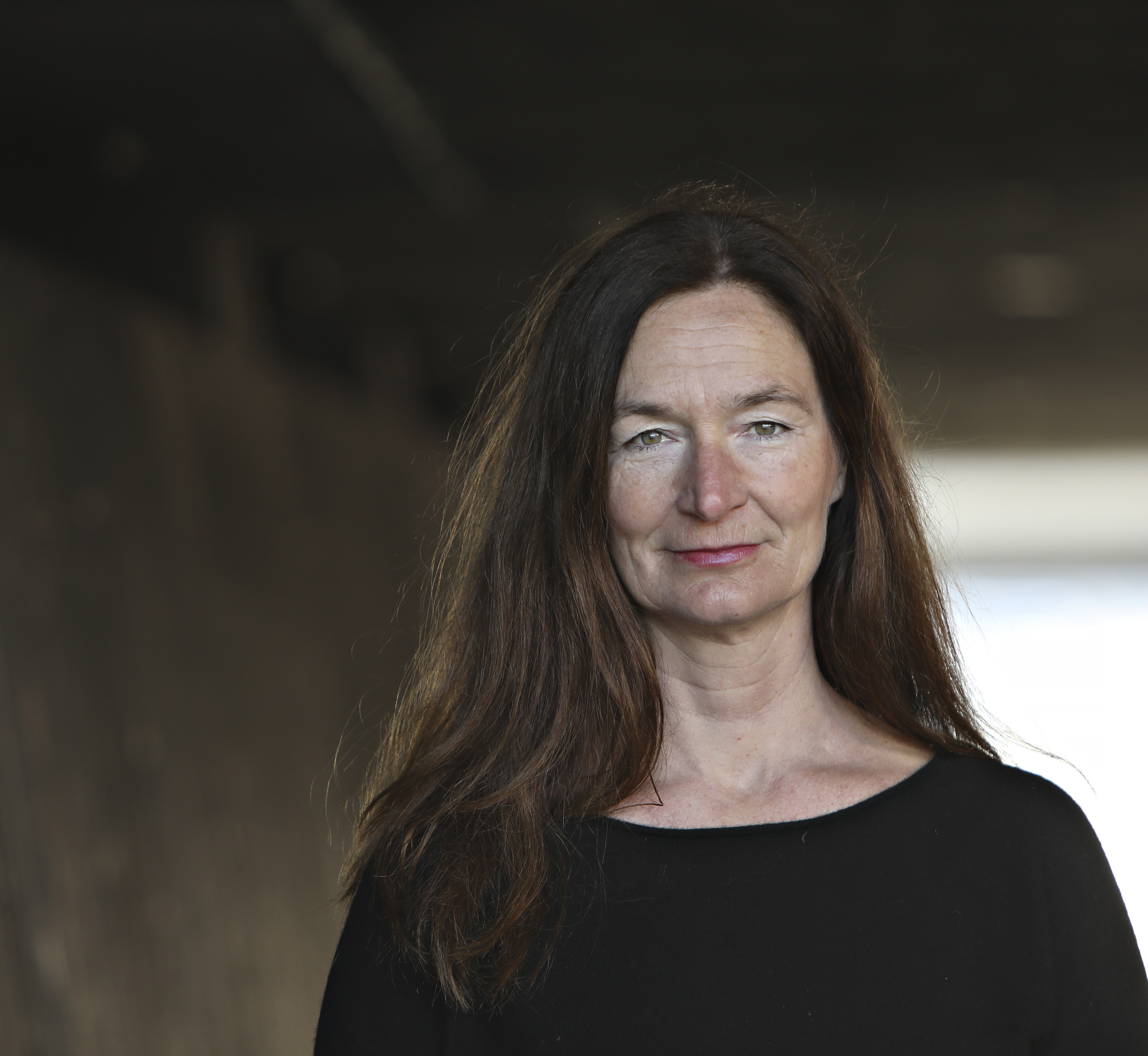
Anne Beate Hovind is a Norwegian urban developer, curator and cultural producer with an international profile in art in public space. With more than twenty years’ experience across art, architecture and civic infrastructure, she is known for initiating ambitious, long-term, site-specific projects that connect storytelling, place and community.
She is the producer and curator of Future Library (2014–2114) by Katie Paterson—a hundred-year literary artwork and one of the most internationally acclaimed long-term cultural projects of our time.
About Kathryn Favelle
A side hustle as an arts writer and editor led Kathryn Favelle to a decades-long career in publishing, public programs and reader services at the National Library of Australia. Kathryn loves talking to writers about their work and has interviewed many, including Geraldine Brooks, Anita Heiss and Liane Moriarty.
This event is delivered in partnership with the Royal Norwegian Embassy in Canberra.
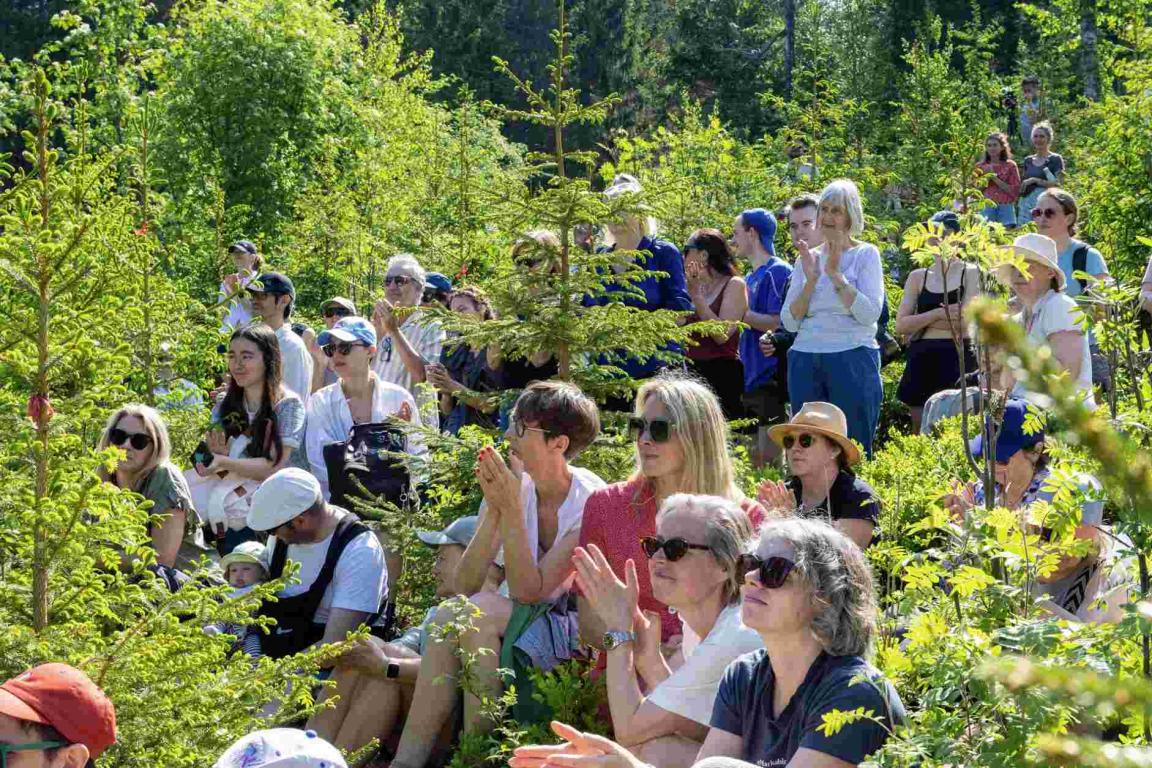
Future Library forest, Nordmarka, Norway
Future Library forest, Nordmarka, Norway

 Assistance animals welcome

 Hearing induction loop

 Wheelchair accessible
Visit us
Find our opening times, get directions, join a tour, or dine and shop with us.