

Beyond the agreement: The regulation of Indian indentured labour in Fiji
In the early-1900s, my ancestors were struggling to survive harsh economic conditions and famine in India. Some were approached by recruiters, who promised good wages and good living conditions working on sugar plantations in Fiji. There, they would work for the Australian Colonial Sugar Refining Company – and the CSR brand of sugar is still sold in supermarkets today.
Given their financial difficulty, some saw an opportunity, and they signed on. But Fiji was further from home than had been described, the conditions of work harsh, and the wages less than promised. They soon discovered they could be sent to prison for not working hard enough and that they would have to stay and work in Fiji for at least five years.
This was indentured labour. Indentured labour was a lesser-known system that followed slavery and saw more than 1.3 million Indian workers transported around the world. Many of them would never return home. This was the story of my ancestors, who came to form the Fiji-Indian diaspora of which I am a part.
People like my ancestors came to be known as the Girmitiya. The word ‘girmit’ comes from the English word ‘agreement’. It is a reference to the labour contract that the workers signed. The identity of the Girmitiya then comes to mean ‘the people of the agreement’.
But why was this contract so significant to the labourers? That is the question that brought me to the Library during my PhD research.

At the Library, I planned to draw on both manuscript and oral history material. Some of the manuscripts I was eager to see were the papers of Professor Brij Lal and Dr Padma Lal, the papers of previous colonial governors of Fiji, and cuttings to do with Sir Edward Knox, the first chairman of the CSR. As to oral history, I wanted to access the Fijian Australian oral history interviews to see whether any of the participants spoke about their Girmitiya ancestors.
During my research, I came across a set of the Fiji Royal Gazettes which are a complete collection of all the laws implemented in the colony of Fiji. Examining the Gazettes showed me that indentured labour in Fiji was regulated by a huge set of laws and ordinances. Hundreds of ordinances regulated every aspect of life under indenture in Fiji, from whether the labourers could drink alcohol to even how they could use the bathroom.
This was a surprise to me. I had previously thought that indenture in Fiji was governed only by the Agreement. Like me, I suspect that many of my ancestors would have arrived in Fiji similarly unaware of the maze of legislation that they were now subject to.
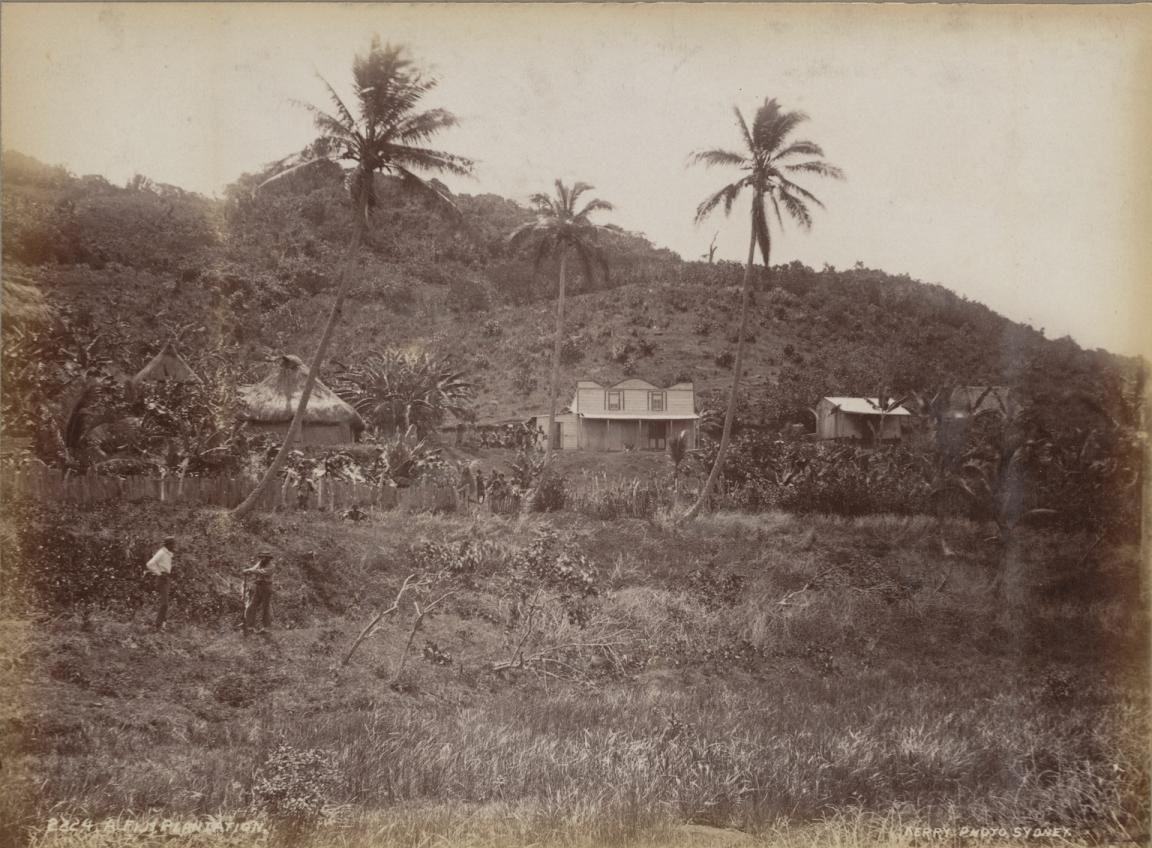
Charles H Kerry, A plantation, Fiji, approximately 1890, nla.gov.au/nla.obj-326066971
Charles H Kerry, A plantation, Fiji, approximately 1890, nla.gov.au/nla.obj-326066971
Additionally, my early PhD findings showed that, after the end of slavery, the British had the labourers sign a contract to document their voluntary agreement to work. But when I turn to oral histories with the descendants of the Girmitiya, I find another story. What the workers had agreed to was not what they were experiencing.
The labourers felt betrayed by the Agreement, they expressed that when calling themselves the Girmitiya. In doing so, they turned a simple legal contract into something potentially more powerful: an identity of resistance. And it is this resistance that was eventually heard during the global movement to abolish indentured labour.
Today, in an age of Australian corporations and governments reckoning with their colonial past in the Pacific, my research makes the signing of the contract the starting point of inquiry. It invites us to look beyond this fact, and to consider the ways these contracts were experienced, contested, resisted and remembered.
The National Library Scholarship offered me the opportunity to do exactly that: to look beyond the contract, and to take in the wider view of the laws and ordinances that governed the lives of my ancestors once they arrived in Fiji.
Natasha Naidu is a 2025 National Library of Australia Scholar, supported by the Professor Robert and Mrs Josephine Shanks Scholarship.
More to explore
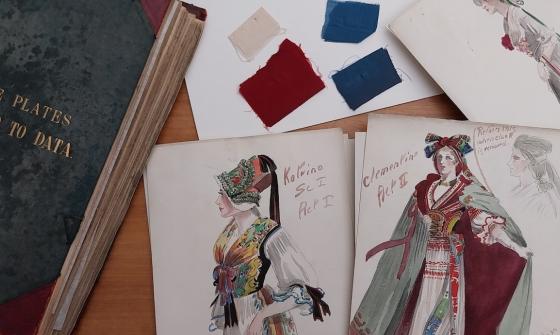
Album of costume designs for a production of Carmen up to data, ca. 1892, nla.gov.au/nla.cat-vn1906313 and Costume designs for The Girls of Gottenberg, c. 1910, nla.gov.au/nla.obj-133118274

Prof. John Morrissey, 2025 National Library of Australia Stokes Fellow