

A ramble through the mind of an adolescent
In February 2025, the Friends of the National Library of Australia invited me to present a talk, delving into Frank Moorhouse’s childhood and adolescence in the 1950s, and exploring how this critical period shaped him as a writer. I also made the case for why an author’s juvenilia deserve more attention in literary biography.
For my fellowship, I am researching the second volume of Frank's biography. Below, I have selected some of his papers including archival sources I have cited in my previous talk on his juvenilia and others I am using in his biography.

Dr Matthew Lamb, 2026 National Library of Australia Fellow
Dr Matthew Lamb, 2026 National Library of Australia Fellow
The Library holds the Papers of Frank Moorhouse. This includes Frank’s early papers, from age 12 up to and including the publication of his first book, Futility and other animals, in 1969 at age 31. This material is uniquely important because it includes Frank’s juvenilia – the literary work he did as a child and an adolescent.
This was roughly the same period when Juvenilia Studies, a new field in the humanities was established by scholars, Christine Alexander and Juliet McMaster. It was early writing which usually proceeds through later as actively abandoning , or otherwise suppressing as a source of embarrassment, what will retrospectively become known as an author’s juvenilia. The term itself carries negative connotations.
Christine Alexander argues that such:
…early writings are non-canonical texts that have for years been considered outside the corpus of respectable material for study; and negative implications of the word ‘juvenilia’ have added to their marginal literary status. The attitudes of authors themselves, of their family and friends, of literary critics and early editors have generally militated against a positive view of the early creative works of writers.
And yet, offering a more positive view of such works is precisely what scholars working in the field of Juvenilia Studies have tried to do.
Alexander and McMaster observed that:
The child’s expression of his or her own subjectivity is there and available for us, if we will only take the time to pay attention. What Juvenilia Studies proposes is that we examine childhood writings as a body of literature, almost a genre, in their own right, and for this purpose...to consider them not just in relation to the adult works of the same author, but in relation to each other.
This is precisely what I have done in the first volume of my 2023 cultural biography, Frank Moorhouse: Strange Paths and what I explored further in my 2025 talk for the Friends of the National Library. Below are the original archival source materials from the Papers of Frank Moorhouse that I have cited in both my biography and in the talk. Both of which provide more complete context.
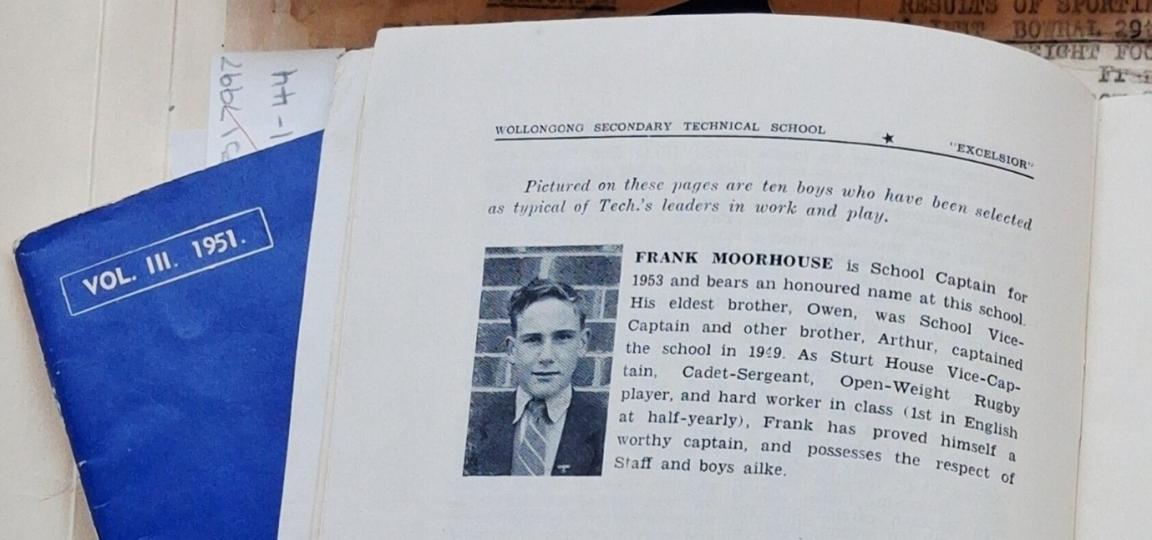
Frank Moorhouse's biography and photograph, Wollongong Secondary Technical School “EXCELSIOR”, p. 14, Papers of Frank Moorhouse, 1953 [manuscript], National Library of Australia, nla.cat-vn1102728
My version of Shakespeare clears up some of the muddle
Juvenilia Studies has shown through an examination of 19th century child writers, from Jane Austen through to Adeline Stephen (Virginia Woolf), that writers often begin through a process of imitation and taking on more established models. This process of imitation, and who you are choosing to imitate also reveals a child writer’s ambition. For example, Elizabeth Barrett Browning, the 19th century English poet at age 13, wrote an epic poem in imitation of Homer. She was asserting her ambition. Likewise, at Wollongong Technical College, in 1953, a 14-year-old Frank Moorhouse attempted to rewrite Shakespeare’s As You Like It. But translated, as he explains in his introduction for the ‘modern schoolboy.' This is young Frank, asserting his own ambition.
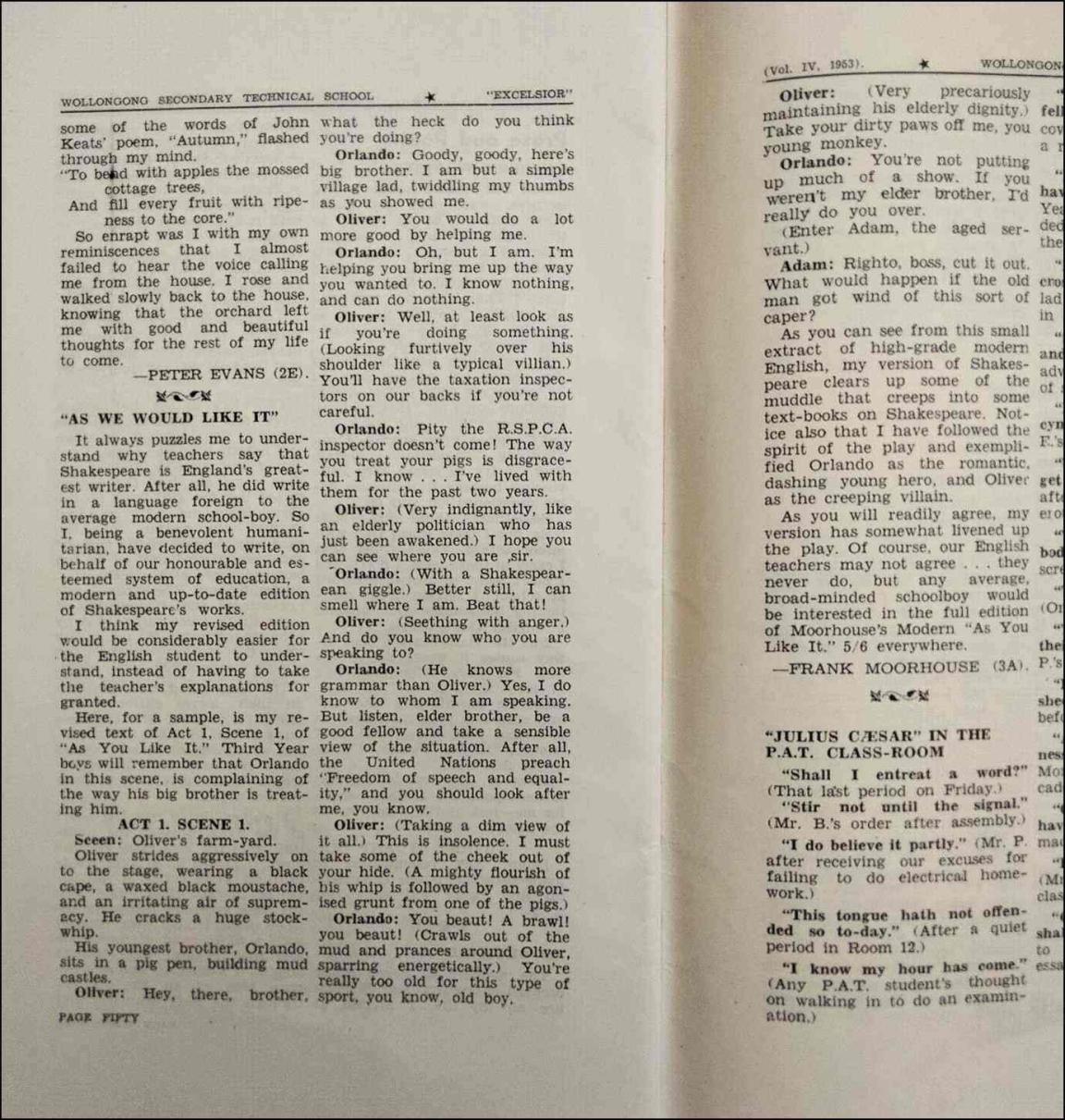
As We Would Like It, Wollongong Secondary Technical School “EXCELSIOR”, p. 50 - 51, Papers of Frank Moorhouse, 1953 [manuscript], National Library of Australia, nla.cat-vn1102728
Boy meets girl’s eyes, repeat
By the time Frank attends Nowra High School (1954-1955), his literary models are Ernest Hemingway, John Steinbeck, and Katharine Mansfield. And yet, his short stories are very much set in his own world, describing his school and home life on the South Coast. But from these models he taught himself about structure and so he would often outline a story before writing it.
There are stories about the difficulties being a school prefect, the challenges of playing sport, the anxiety of going to a school dance, the boredom and doubts of going to church, the joys of hanging out at a milk bar with friends. In one story, he describes a boy’s first kiss. Here is the outline and the first page of the subsequent short story, called Tch! Tch!.

Frank Moorhouse's plan for a story, Papers of Frank Moorhouse, 1951 - 1970 [manuscript], National Library of Australia, nla.cat-vn1102728
Frank Moorhouse's plan for a story, Papers of Frank Moorhouse, 1951 - 1970 [manuscript], National Library of Australia, nla.cat-vn1102728

First page of short story, Tch! Tch!, Papers of Frank Moorhouse, 1951 - 1970 [manuscript], National Library of Australia, nla.cat-vn1102728
First page of short story, Tch! Tch!, Papers of Frank Moorhouse, 1951 - 1970 [manuscript], National Library of Australia, nla.cat-vn1102728
To become a writer of the highest standard, it is necessary to study
Frank Moorhouse spent much of his adult, public life arguing against censorship, arguing in favour of free expression, and exemplifying the life of a writer in constant renegotiation with the conventions of their own society. Remarkably, Frank already held these views as an adolescent. Even as a high school student he understood the value of education for his future as a writer.
He also understood that he needed a day job that would allow him to pursue his writing. Here we see two letters Frank wrote in 1955, when he was 16 years old during his last year of high school. The first is to the Daily Telegraph in Sydney, where he applied (successfully) to be a copy boy, with a view to becoming a journalist. The second letter is to himself, a positive affirmation to steel him during his final exams.

Letter - My reasons for entering journalism, Papers of Frank Moorhouse, 1951 - 1970 [manuscript], National Library of Australia, nla.cat-vn1102728
Letter - My reasons for entering journalism, Papers of Frank Moorhouse, 1951 - 1970 [manuscript], National Library of Australia, nla.cat-vn1102728

A letter to myself written 4th April 1955, Papers of Frank Moorhouse, 1955 [manuscript], National Library of Australia, nla.cat-vn1102728
A letter to myself written 4th April 1955, Papers of Frank Moorhouse, 1955 [manuscript], National Library of Australia, nla.cat-vn1102728
The boy who tried
What is remarkable about Frank’s writing in the mid-1950s is that he self-consciously takes as his subject matter the category of ‘adolescence’. He is not simply writing from the perspective of an adolescent; he is taking ‘adolescence’ itself as his object of inquiry, while at the same time contrasting it with the adult world – rather than simply trying to assimilate his writing to that world.
By the time he was 16 years old, he had already written a number of short stories on various aspects of this theme of adolescence. He then grouped these stories together and gave them the collective title, This; the world of the adolesense (sic). This is arguably the content page of the first unpublished collection of short stories Frank had written.
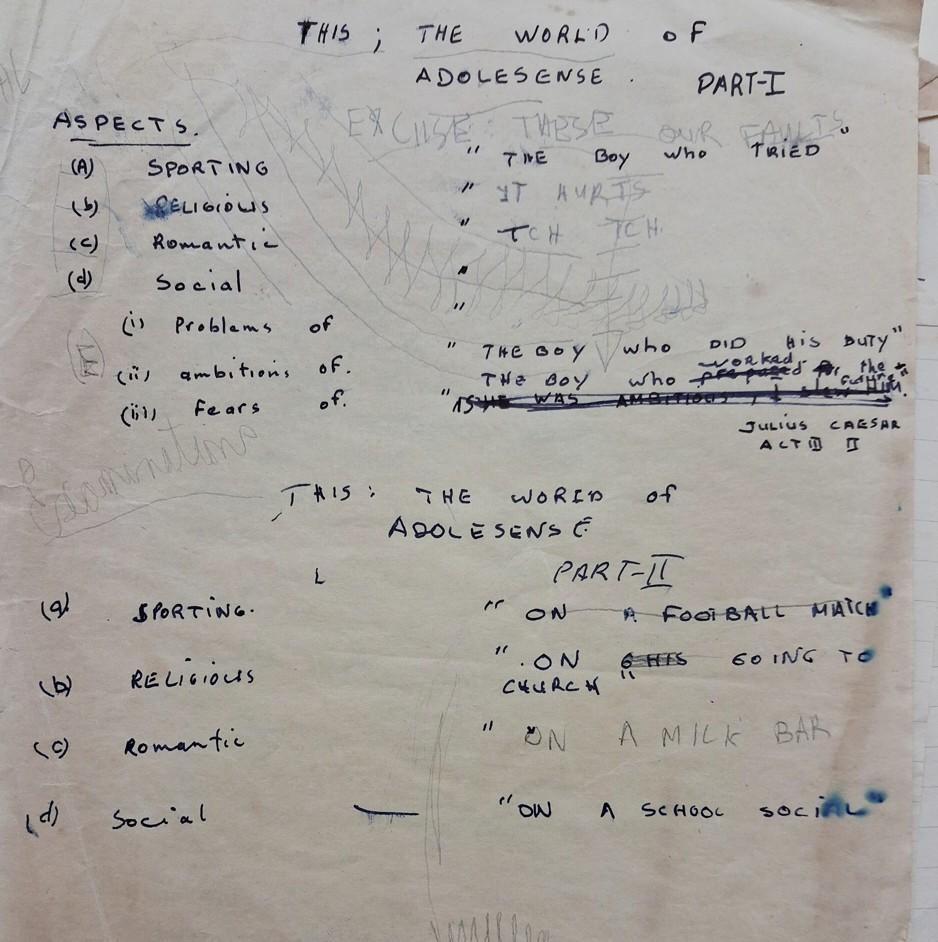
This; the world of adolesense, Papers of Frank Moorhouse, 1951 - 1970 [manuscript], National Library of Australia, nla.cat-vn1102728
In fact, the whole story should reek of adolescences
In his final year of high school, after Frank had written these essays and short stories, he began to write a novel. Again, he takes ‘adolescence’ as his subject matter. He finished writing it in 1956, when he was a cadet journalist in Sydney. When he finishes, he writes a preface. This is a remarkable document in which a 17 year old Frank recognises in the 1950s – in himself, in his generation – the seeds of disaffection that would become more prevalent throughout Australian society in the 1960s, especially in the generation coming up under Frank.
This document displays a remarkable interplay between the genuine intellectual and expressive limits of being an adolescent, together with an uncharacteristic self-awareness of those limitations and a burning desire to transcend them.
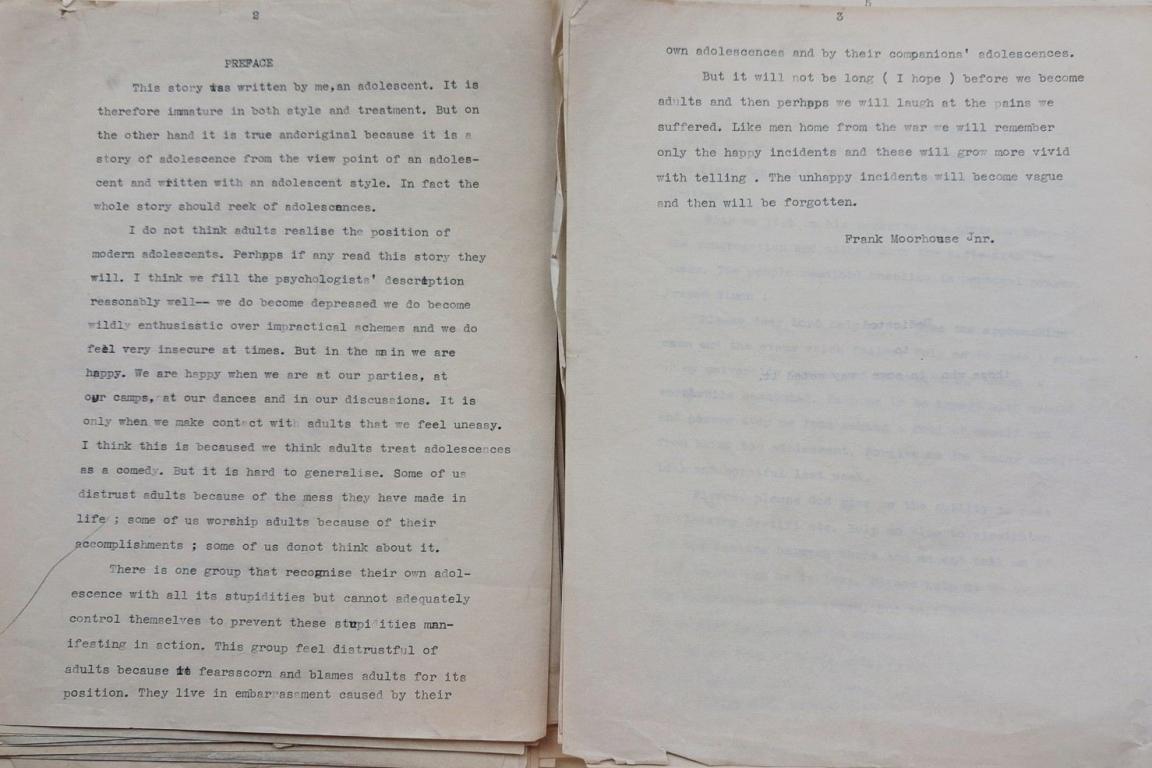
Pages of novel Preface, Papers of Frank Moorhouse, 1951 - 1970 [manuscript], National Library of Australia, nla.cat-vn1102728
I must express the inner excitement I feel
As a cadet journalist in Sydney, Frank started keeping a daily journal. On the first page he typed:
Today I have decided to write a journal. I am aged 18 years and 5 months. I think the journal will consist of what I call 'significant incidents' which will provide material for future literary work.
And it did. One of the sections from this journal would later become a story, printed almost verbatim – in Frank’s 1988 book, Forty-Seventeen, when he was 49 years old. It also contains the fragments of experience that he would pull together to write what would become his very first published short story, The Young Girl and the American Sailor, which he finished writing in November 1956, just shy of 19 years old. It was published in Southerly in 1957.
Around this time, he wrote in his journal about the inner excitement he felt when he finished writing a short story. It would be a feeling he would chase for the rest of his life.
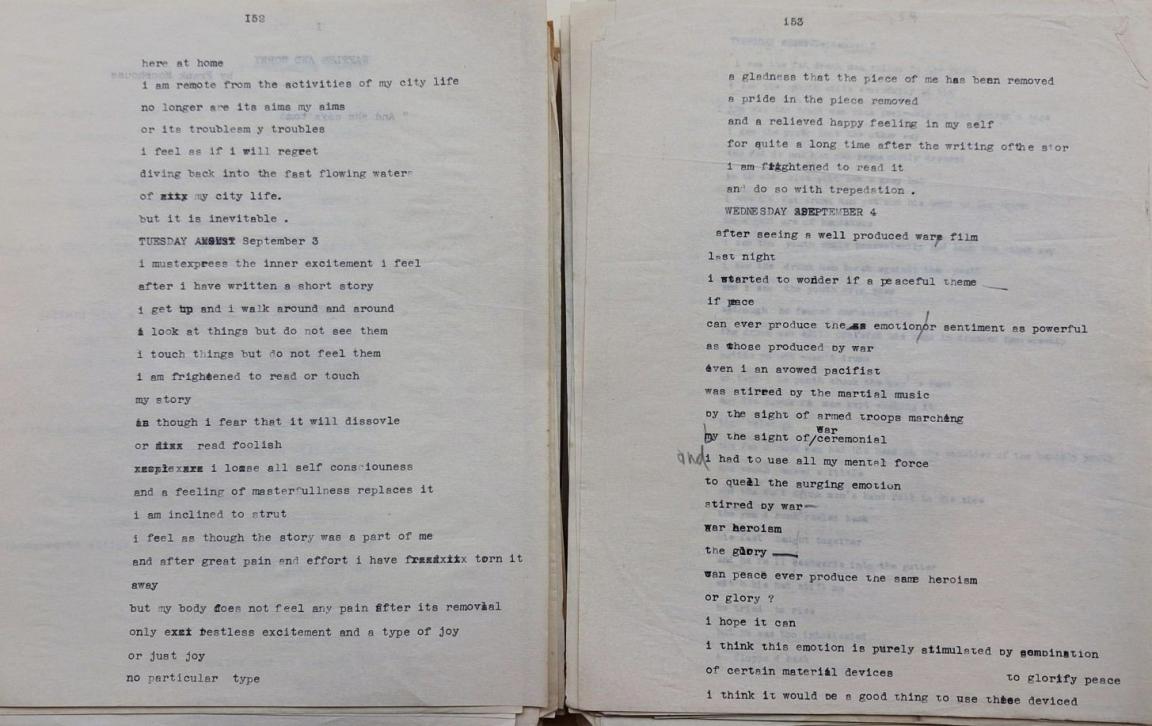
Pages of journal - entry beginning to I must express the inner excitement I feel..., Wollongong Secondary Technical School “EXCELSIOR”, p. 152 - 153, Papers of Frank Moorhouse, 1951 - 1970 [manuscript], National Library of Australia, nla.cat-vn1102728
Dr Matthew Lamb is a 2026 National Library of Australia Fellow, supported by the Ray Mathew and Eva Kollsman Trust.
More to explore


Dr Matthew Lamb

Prof. John Morrissey, 2025 National Library of Australia Stokes Fellow