

Woodland Collection
Key items in the collection
Highlights from this collection demonstrate its historical significance and variety.
The Chris Woodland Collection contains 27 tape recordings and digital tapes of traditional music, recitations, folklore and oral histories recorded in New South Wales between 1968 and 1995.
Several of the interviews deal with the history of Araluen, while others discuss the work of:
- drovers
- bullock drivers
- shearers
- stockmen.
The performers and interviewees include:
- Neta Davis
- John Dengate
- Denis Kevans
- John Meredith
- Edgar Penzig.
About Christopher David Woodland
Christopher David Woodland (born 1938) was born in Kempsey, New South Wales, and grew up in Taree and Sydney.
Education
Woodland was educated at the Bondi Junior Technical School and Ultimo Technical College and served an apprenticeship at the National Standards Laboratory.
Meeting people and affiliations
He spent some time working in various jobs in western New South Wales and Queensland. During that time Woodland became acquainted with Edgar Penzig, the authority on bushrangers, and was introduced to the Wild Colonial Days Society.
In 1962 he joined the Sydney Bush Music Club, where he met John Meredith, and learnt to play the mouth organ and button accordion. (Also refer to the Meredith Collection, Peter Ellis Collection and Willis Collection.)
He has always maintained his interest in Australian music and has been an active member of the Monaro Folk Music Society.
Woodland accompanied Meredith on some of his travels in the 1960s and, in particular, visited the Araluen Valley and became familiar with its history.
In 1994, he again accompanied Meredith on his last field trip, when they travelled to Orange, Brewarrina and Cunnamulla.
Locations
In 1968 Woodland obtained a job as a machinist at an explosives factory at Mulwala, on the River Murray. After about 4 years, he moved to Canberra, where he has lived ever since.
For many years, he was on the staff of the School of Automotive Engineering at the Canberra College of Technical and Further Education (later the Canberra Institute of Technology) and for a time he also worked at the National Science and Technology Centre.
Collecting
He began collecting oral history in 1968, when he recorded the singers John Dengate and John Small, and he interviewed singers and bush workers whom he met in Mulwala and Araluen.
Background to the collection
The Library began acquiring recordings from Woodland in 1987 and it provided financial assistance for his field trips in 1993–1994. Further recordings were acquired in 2001 and 2005.
The Chris Woodland Collection is held in the Oral history and folklore collection at various locations. They have all been catalogued.
Keith McKenry, Oral history interview with Chris Woodland, 2004, TRC 5102.
Continue your journey

More to explore
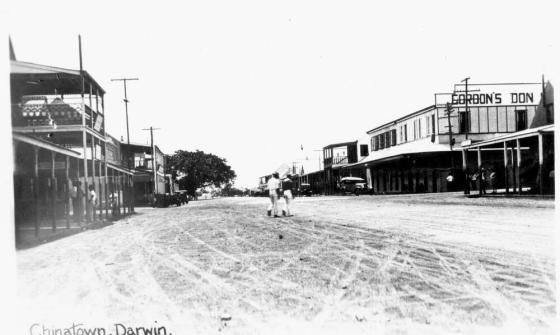
Chinatown, Darwin, 1930, nla.gov.au/nla.obj-136768825