

Enlighten 2026: Artists Q&A with Eleanor and Giovanni
Using painstaking stop-motion animation, local Canberra artists Eleanor and Giovanni created our stunning illuminations for the Enlighten Festival 2026.
This conversation provided insights into the technical process of stop-motion animation, featuring time-lapse footage, models and other behind-the-scenes material resulting in the creation of The Page Turner.

Visitors are welcome to take a stroll in the Parliamentary Triangle after the talk and enjoy illuminations from 8:00pm.
Enlighten 2026: Artists Q&A with Eleanor and Giovanni
Daniel Gleeson:
Well, hello, good evening. A small but enthusiastic crowd, the others put off by the impending thunderstorm, I assume. Welcome to the National Library of Australia and to this wonderful event - Eleanor and Giovanni in conversation with Adam Deusien. My name is Daniel Gleeson and I'm the Director of Community Engagement here at the Library. Before we begin, can I ask that mobile phones are please switched off or set to silent? I'd like to acknowledge Australia's First Nations peoples, the First Australians, as the traditional owners and custodians of this land, and I pay my respects to their elders past and present and through them to all Australian, Aboriginal and Torres Strait Islander people. The library sits on the land of the Ngunnawal and Ngambri people. I thank them for their continued care of this place we call home and recognise that they, along with all First Australians, are the original storytellers, performers, and keepers of culture in this place.
We're so thrilled to have you all here for this very special event, which is presented by the National Library in partnership with the ACT Government and the Enlighten Festival. Of course, Enlighten is an annual event which sees all the national cultural institutions in the parliamentary triangle light up with those beautiful projections. Normally, we here at the Library would create our projections by drawing from our very wide, very vast, very deep collection. We've got many beautiful documents, but we also have photographs and music and oral histories, and we can pull those items together and make something really visually stunning. But this year we did something completely different. We approached a small number of visual artists and we asked them for proposals. We asked what they could do with our beautiful building. And we were so pleased when Canberra artists, Eleanor and Giovanni, absolutely knocked our socks off with their proposal to develop a five-minute animation created with paper and containing clever references to the library and to some of our collection items.
It's my pleasure tonight to introduce Adam Deusien, who will be leading the conversation tonight with Eleanor and Giovanni. Adam is the creative director of Canberra's Enlighten Festival. Adam is a live performance and festival director with over 15 years of experience as both an independent artist and a programmer and presenter. He's a graduate of Charles Sturt University with a Master of Arts in Directing For The Stage. And in 2018, he graduated as part of NIDA's inaugural cohort of the Master of Fine Arts in Cultural Leadership. He has worked as the Artistic Director of Regional Arts Festival Art State, Associate Artist at the Bathurst Memorial Entertainment Centre, manager of new work and sector development at the Canberra Theatre Centre, head of programming for FYI Canberra and creative producer for the new annual festival in Newcastle. I'll leave it to Adam to introduce Eleanor and Giovanni. Please join me in welcoming Eleanor and Giovanni in conversation with Adam Deusien.
Adam Deusien:
Thank you so much, Daniel. I didn't know you were going to read my bio as well. So if I was sitting here like this, it was definitely kind of like, it's always that moment of what I'm about to do to both of you as well when I read your bio, of course. But it's really lovely to be here - Daniel, thank you so much - to talk to these incredible artists and really exciting, I'll just say from the Enlighten Festival's perspective, of course, that the work that the Library has always done with Enlighten with the illuminations, which are of course of the major architectural projections that we do, and to work with contemporary visual artists and to see what that does and what artists do when they approach a mission like this with all of their integrity and all of their creativity. So thank you, Daniel. As Dan said, my name is Adam Deusien.
I'm the creative director of the Enlighten Festival, and it's always such a joy to be back on Ngunnawal Country, but I am so delighted to be here today with Eleanor and Giovanni. And like I just said, to kick us off, I am going to read your bio so that everyone knows exactly who you are before we launch into you telling us exactly who you are, but it's such a delight to be able to talk to you this evening. So for everyone in the room, Eleanor Evans and Giovanni Aquilar are Canberra based artists and animators working in intricately handcrafted stop motion animation. Eleanor and Giovanni met in 2016 while studying a Master of Stop Motion Animation at BAU Design School in Barcelona. Since that time, they have worked together on more than 15 animated music videos and short films, which have been screened worldwide in film festivals, as well as animated musical segments that have appeared on Nick Jr and SBS.
Key to Eleanor and Giovanni's collaboration is bringing together their different skills with Eleanor's work in experimental animation and Giovanni's experience as a graphic designer and a musician. So an incredible amount of different practises that come together to synthesise this work. So I thought maybe we would kick us off this afternoon with each of you giving us a bit of an introduction to your practise and more about your work.
Eleanor Evans:
Okay. Hi, we're Eleanor and Giovanni. And as Adam said, we do stop motion animation and a whole variety of different mediums. In fact, this is one of the reasons why we love stop motion because I like to say that stop motion animation is like a medium for people who can't decide what medium they want to work in because it's a type of animation that you can use any type of art and move those objects frame by frame. And when you put that in sequence, you can make a film and that's basically what we do.
Giovanni Aguilar:
Yeah. I think stop motion animation also packages a lot of things, a lot of ... It can absorb different ways of art and materials, especially. And it translates always the textures really well. So that's probably one of the things that I enjoy about it. And you too, because you do a lot of knitting and a lot of handcraft arts. So I think we are just passionate about textures and that type of visuals. Yeah. Yeah.
Adam Deusien:
Beautiful. We've got some examples of your work here. I might play the first one for people and then maybe you can talk to a little bit about what this work is and the process.
Video narration:
Head, shoulders, knees and toes, knees and toes. Head, shoulders, knees and toes, knees and toes, head shoulders knees and toes, knees and toes. Eyes and ears and mouth and nose, Heads, shoulders, knees and toes, knees and toes, heads shoulders knees and toes, knees and toes, heads shoulders knees and toes, knees and toes.
Adam Deusien:
Gorgeous. This is Face's Music Party for Nick Jr, wasn't it?
Eleanor Evans:
Yeah. So in this process, we made very different puppets for this than what we have in the projection, actually. So we wanted to make robots that were made from different kinds of materials. A lot of this is like hard plastic and metallic fabrics. We really love shiny things. A lot of stop motion animators avoid shiny things entirely because they're terrified of like reflections into the camera that can cause some kind of flickering. But what we find is that that actually doesn't happen very often. So you just have to be a bit brave and go for it.
Giovanni Aguilar:
Yeah. I agree.
Eleanor Evans:
Do you want to say something about the puppets, Gio?
Giovanni Aguilar:
Well, we had this challenge of making robots that were cute for kids. So it was a challenge because sometimes robots can be a bit aggressive. So we have to look for round shapes and just colourful robots that are friendly. And I think they did what we wanted. Yeah.
Adam Deusien:
I think as well, maybe it's a good opportunity to ... I think many of us are probably familiar with at least the term stop motion animation, and there's all different types of it as well, but I'm sure that you've got some specific insight. And maybe if you could just talk us through exactly what stop motion is and what your process is, just so that we can get a little bit of insight into just exactly how much of an intricate process it is.
Eleanor Evans:
Stop motion is the process of creating animation through a series of photographs. So for example, if I wanted to make a stop motion animation with this bottle, I'd put it here and take a photo, take a photo, take a photo. But the thing is that when you think about puppets and how many different moving parts there are, it's essentially like trying to do that with a person. So imagine if you move your shoulder, you move your hand, you have to move all different parts of your body to rebalance how you're standing, to fight against gravity. We have to do that frame by frame with every part of the body of the puppet.
Giovanni Aguilar:
Yeah. And something a bit more technical is that we can do animation in 12 frames per second or 24 frames per second or, well, you can do basically whatever frame of per second you want, but the standards are 12 or 24. And we often choose to do 24 because it's more smooth, the movements, but it takes twice the time to do a second because it's basically 24 pictures. So yeah.
Adam Deusien:
And it sounds very time consuming. That's a very obvious thing to say, but there must be something really delightful in the kind of intricacy and the kind of ... It's constant iteration, right? As you were describing, Eleanor, it's like moment to moment to moment to moment that as in our daily lives, we kind of thoughtlessly most of the time move around the world, but you're kind of deconstructing it like part of a second to a part of a second. What draws you to this practise?
Eleanor Evans:
Well, sometimes we say slightly jokingly that it's a kind of meditative process, but I actually do enjoy that it does make you think about things in a sort of slower sense. Like you can start to see the frames in movies, you start to see the frames in other animated shows. And I think, I don't know, there's something about that observation that I enjoy.
Giovanni Aguilar:
Yeah. I feel that we normally see a music video and we think of this five or four or three minutes, but when you have to approach it as a stop motion animator, you just plan everything and you basically divide every second or every couple of seconds. And it's just like a constant type of work because as soon as you plan everything like that, you just have to break it in seconds. And yeah, it's not too much when you break it like that. Yeah.
Adam Deusien:
There's something in the coming together of like planning and creativity by the sounds of it, which I can imagine is quite satisfying and seeing it kind of come together over a long period of time. Yeah.
Eleanor Evans:
I think the other part of it is that the process might be kind of time consuming, but it's actually something you can do quite well with a very small team. There's just two of us and we can make quite complicated projects and some of the types of animation require specialists who work in very different areas, but we're able to do everything just between the two of us.
Adam Deusien:
Yeah, that's great. I wonder what could be really interesting is to hear a little bit more about the details of when you are collaborating together, what does that look like between the two of you to make this work?
Giovanni Aguilar:
I will say that we, well, we both think that art is not a competition and also ideas are not a competition. So we try to edit our ideas. So Eleanor has an idea and then I add something or remove something and we start bouncing the idea between us. And at the end, we don't know who was the originator of the idea because for example, for the monster, Eleanor had the idea of the monster, but we talked so much about the colours and I was very like annoying, I guess, with the colours.
Eleanor Evans:
But that's the other part of it is because we have quite different skills. Gio is a graphic designer, so if there's like technical things to do with colours, for example, I'll always go to him, but there are other things like I'm a bit more of an editor, so I do a bit more of the editing at the end of our projects, so we just kind of divide it based on our skills. Yeah.
Giovanni Aguilar:
But the best thing was that because she made all the colours, so she would try with so many different inks, but when the inks were the right ones, we both were super happy. We were like, "Yeah, you look amazing." Yeah. So I think it's a pleasure when these things happen because sometimes also she has very particular things about a shot if I do a movement or if I have to repeat something, something that it's like, "I have to repeat it. " But then we both are happy when we get that result. Yeah.
Adam Deusien:
Yeah. Changes. Last minute changes must be pretty tricky, I imagine in this kind of work.
Eleanor Evans:
Yeah. I don't know if you have seen our entire original storyboard for the Enlighten projection, but if you look at it, we barely changed anything and that's basically how you have to work in stop motion. You have to have a very clear idea about what you're going to do because edits at the end are so difficult. Yeah.
Adam Deusien:
There's also, just hearing you talk about how your collaboration works as well, just sounds so extraordinary. I think a lot of artists look for that type of collaboration like their whole careers, like that level of not only having complimentary practises, but the ability to get to the end of a process and it just have been so organic and synthesised that you kind of like, there's just no way but to share the work. It sounds really, really beautiful and sounds really like a rich and fruitful collaboration.
Eleanor Evans:
Yeah. We're married as well, so we're together 24 hours.
Adam Deusien:
Okay. That would certainly help, I imagine. Maybe, but we won't talk about that today. We've got another of your works to show before we get to the main event, which is talking about The Page Turner, your work for Enlighten. So I might play this. This is Ain't Many Like Lenny, which was a music video for CJ Shaw, but we'll watch it now.
Video narration:
Gather around and I'll begin. With a little yarn to spin and trust the singer when they sing. There ain't many like Lenny if any.
Adam Deusien:
Beautiful. What can you tell us about this work?
Eleanor Evans:
Well, this project actually has quite a strong connection to the Library because it's based on the true story of Lenny Gwyther who rode his horse, Ginger Mick, to see the opening of the Sydney Harbour Bridge from Leongatha in Victoria by himself. And this happened in 1932, and you can trace the story day by day in Trove, if you look up the newspapers. So that's what we did to get the inspiration for this music video. The clothes are based on the real photographs of this person, the horse is inspired by the real horse, and every shot is inspired by real photographs in newspapers.
Giovanni Aguilar:
Yeah. In fact, we did some replicas of some of the newspapers that we found, and we made a one shot where all the newspapers appear, and yeah, it's basically like the newspapers we found in Trove.
Eleanor Evans:
And the characters in this are done with needle felting. Needle felting is a really lovely technique for stop motion animation because it's very flexible. So with stop motion animation, you have to have some kind of moveable, manipulatable skeleton inside. They have a wire armature inside these puppets, and because their skin is felt, they can move in just about any direction without any damage to the puppet. It's a really lovely material to work with. Yeah. Yeah,
Adam Deusien:
It's beautiful. And a collaboration ... I wonder what the collaboration was like with CJ Shaw as well, the musician, because I imagine that there was ... Did you take the idea to them? Yeah, what was that like working with the musician?
Eleanor Evans:
Yeah, CJ came to us. CJ is a teacher. He at the time was a teacher in Canberra, and he makes educational music. And I think that he found us on Instagram and just got in contact. And now we have a really lovely collaboration with him as well. We've done other projects for him. So I think that's lovely to work in the modern age where you can connect with artists like that. Yeah.
Adam Deusien:
Yeah. And speaking about collaboration with other organisations and artists, I think we should have a bit of a chat about how The Page Turner came about here for Enlighten. So it was a bit of a wonderful journey as well. So I wonder, start us at the beginning and tell us a little bit about when you were approached and the beginning of your pitch and the idea and how you developed the concept as well.
Giovanni Aguilar:
I think the first thing we did was take a tour in the Library. And well, especially for me, because I'm not like ... I was not born here in Canberra. This building, I just have seen the building from outside, but not from the inside. So learning the ... All the things that the building has inside for me was fascinating. And also the idea of preservation was some of the things that I was fascinated how like things are preserved in different medias and the history of things. And there's so many things and the windows and everything. Yeah.
Eleanor Evans:
I think we were really lucky because I think the Library was very open to different ideas and the theme of Enlighten having like adventure and curiosity. That's such a wonderful theme for animation that can go in all kinds of directions. So I think that I felt really supported in the application process actually. Yeah.
Adam Deusien:
Yeah. And you can see here that this was the brief that you would have responded to in the first instance. So what the Library has asked for this year was for artists to respond to the idea of - tell a story that sustains audience interest, aligned with the festival themes of embracing the unknown adventure, curiosity, and acknowledges the National Library of Australia. And it sounds like you found all these immediate alignments with your own practise as well. And maybe what you responded to aesthetically, which I think is one of the great, like the core success of the work as well, is how you used paper in the whole process of the work.
Eleanor Evans:
Yeah. We thought we're planning to do something for a library. We want to use the most library material you can think of - paper. I think I love to just pick up a book and just sort of turn through the pages and just smell the paper and just hold the book. And we wanted to get that kind of experience and project it onto the outside of the Library to give the experience of going inside a book.
Giovanni Aguilar:
And paper has one characteristic, which is it's very fragile. I mean, the clothes of The Page Turner are all paper. So we had to engineer how to fold certain things so when it jumps or whatever movement it does, it doesn't break. But at the same time, I think paper in the library is, if you think old books are made out of paper, till this day is very resistant material. So it has this duality. And for me, that was one of the things that I thought this is a great material, but very challenging as well.
Adam Deusien:
For sure. And I think we'll hear a bit more about those challenges as we get through this. What are we looking at here, these beautiful colours?
Eleanor Evans:
This is an image from our proposal. So at the top, these are rice paper tests using different dyes and paints to try different colours. And underneath, these are using cellophane and black paper to make these lovely silhouettes, which was a technique we used in the wings when the puppet flies. Yeah.
Adam Deusien:
Let's talk a little bit about the story that you proposed as well. So we follow a particular character and then encounter a second on their adventure, but where did the idea for the story come from for you?
Giovanni Aguilar:
I think the idea came from this exploration of this character through not just his life, but multiple books. And I think, yeah, every person experience life and gets some ideas, but books have also deep impact in life. So we want that mixture of the experience of the puppet through the journey, but also the puppet interacting with some books or some stories from books. So when the puppet find this giant book, somehow he explore sort of different ideas of stories for kids. That was the inspiration we had. And then he find the monster and he has to overpass that.
Adam Deusien:
We keep talking about this monster as well, and I promise you'll get to see exactly what we're talking about soon. But sorry, Eleanor, I think you were about to say something?
Eleanor Evans:
Yeah. It's like a bit of a love story to the process of reading because at the very beginning, you'll see letters flying overhead above the character and he's jumping up and catching these letters. It's essentially like him learning to read and him connecting with the concept of reading and then going through these different journeys, as Gio said. And often when you're a reader, eventually you start to want to be a writer yourself. So towards the end of the story, he starts to have his own ideas and he writes his own book and then he passes it onto the next generation, which is what the other character who you can see at the bottom represents. She is the next generation of readers finding the book written by The Page Turner.
Adam Deusien:
Yeah. Beautifully cyclical. And I think so many people could probably resonate with exactly what you just said then about how a love of books leads to a love of writing and a love of words. And I think it's totally captured in the illumination as well. This is also from your proposal, I believe. And it would be interesting to hear about your relationship to your process with working with the architecture as well, because I don't think you've worked on ... This is the first time you worked on major architectural projection, and we of course work with a company called The Electric Canvas who helped to deliver all of the illuminations. I wonder if you could tell us at this point a little bit about that process for you and that collaboration.
Giovanni Aguilar:
I felt quite familiar because I'm a graphic designer and we work with grids all the time. So for me, it was more or less like, well, this is the grid we have. We have to interact with this grid somehow. So yeah, we started to find creative ways to the puppet walk behind the columns and flying and doing things that make the building interesting. And I think, well, we have been coming every day watching the projection and analysing and over analysing the projection. And we noticed that we decided not to have things all the time jumping in the building as a choice. And I think that also focused the viewer to one specific action and follow this story, which I think that the building also helps with that because it's quite like just one big wall with not too many complicated structures around.
Adam Deusien:
Yeah. And the great thing about this facade is that it can feel like one screen, but you also have the opportunity to kind of engage with, I think it's seven, it's almost can be seven, I mean, I shouldn't use the word screen, but like seven sections of it as well. So you can really compartmentalise part of the story. And in some sections, you beautifully do that. And then in other sections like the monster I keep talking about and, the entire building becomes something as well. Were there any ... Oh, it's coming up next. I've just been just looking at it now, so it's on its way. Were there any surprises for you in working with the architecture? Either way, was there something that was particularly challenging or maybe something that was really, really fun to work with in this architectural context?
Eleanor Evans:
Well, there was something we learned that was actually in the previous image, if you can go back. Oh, good.
Adam Deusien:
Shall I go back to this?
Eleanor Evans:
This one?
Adam Deusien:
Yeah.
Eleanor Evans:
Which is that you can see in this image that we've used this, as you say, as one big screen, but as we learned as we were speaking to The Electric Canvas, all the different sections from different angles, it'll change the perspective. So in the end, we didn't have the columns projected with the masts of the ship and we couldn't extend the book onto the ceiling. So the perspective is a little bit different in this. So that was something that we learned while working with The Electric Canvas.
Giovanni Aguilar:
Yes. Especially in this shot, we had to move the book back and forth so people can see all of the elements because Eleanor worked so hard to make these pop-up books. And then when we had the first test, the book didn't move. So we lost one part of the ... Well, there's a house in one of the sections of the book and we put even lights inside. So when it opened, it lights up. And Eleanor said to me, "Well, but we put this little hard window and it's not seen."
Eleanor Evans:
It was hidden by the column. Yeah.
Giovanni Aguilar:
And I was like, "Oh my God." And then we decided to move it back and forth as a part of the magic of The Page Turner. It was resolved. So yeah, we learned how to fit certain things in that way.
Adam Deusien:
Yeah. And I really encourage you all as well when you get the opportunity, when the illuminations come on at 8pm after this talk as well, to really notice that detail in terms of the depth. So you'll notice that the kind of panels that you can see on the front of the library, often the work is kind of set behind the poles, which gives you this sense of real depth in the building. It's such a specific choice that they've made. And also when you do the invert, the opposite of that as well sometimes. Keep an eye out and see, because it's such just a fine detail that really changes the experience, I reckon. Here's the beautiful monster we keep talking about. Do you want to tell us a little bit about this folk?
Eleanor Evans:
We just wanted to bring some adventure to the audience as well. And so the monster, the idea is that the eyes are looking out at the audience and it looks around in all different places. And it's meant to be sort of growling at the audience, but we don't want it to be a particularly scary monster. We think it looks kind of friendly and cute as well.
Giovanni Aguilar:
And something that I like about the monster is that because yesterday when we were leaving, we were going through ... how is the name of that road? We were driving that we stop where the flags are located. The other side of the lake. From the other side of the lake, we were watching the projection and we could see the monster. And I thought- Amazing. The monster is- It's so big you can...
Eleanor Evans:
See it from the other side of the lake.
Giovanni Aguilar:
Yeah, you can see it from so far away. And so yeah, it's like having these two elements that some can be seen just from very close and some things can be seen even from far away.
Eleanor Evans:
And that's nice because you can see the Library from all the way up at the Portrait Gallery. So hopefully when people see these large elements, they go, "Oh, I want to go and have a look at that. "
Adam Deusien:
You certainly do. I was standing up at the National Portrait Gallery, I think last night, and you can see all the way down. You can see I think four of the illuminations from there. And you certainly are drawn there. And I do think our mate here certainly popped up while I was standing up there. Do they have a name?
Eleanor Evans:
No.
Adam Deusien:
Great. Well then-
Eleanor Evans:
It's the Library Monster.
Adam Deusien:
The Library Monster. Someone good with words, maybe can come up with a name and let us know. We've got some examples here from your process of making the work as well. Do you want to tell us a bit about this?
Eleanor Evans:
Yeah. So this is a mock-up for one of the pop-up pages. I'd never made pop-up books before this project. My little sister loves them, so she gave me a lot of advice, but it took a lot of different tests to get to a point where I had a pop-up that worked the way I wanted. I think it took me two weeks to make the book. Yeah.
Adam Deusien:
We've got an example of, I think, from your work as well of the result of that two weeks as well. Pretty good for not having done it before, I have to say. Is it something you'll do again? Did you enjoy it?
Eleanor Evans:
Oh yeah, I loved it. It was a lot of fun. And I think this is the other thing I really love about doing stop motion, because every single project we have to learn completely new techniques depending on the theme of the project. So that's always fun. Yeah.
Adam Deusien:
This next clip that we have here is I think a little bit of you doing the stop motion itself. Can you tell us a little ... Well, I think you could probably tell us a little bit about this, Giovanni. How long does this represent? How much work?
Giovanni Aguilar:
Few days. Yeah. Like three or four days, because this is a very long shot. It's like, I think it's probably 10 minutes, 10 seconds, this one. And yeah, it has also a different interactions. For example, the pencil, we have to make different sizes for the pencil so it can stretch. So we have a tiny ... Well, you can see the pencils in the foyer. We have a tiny one and then it grows, grows, grows. So we just swap each pencil at the time and it just grows. And then is when it flies as well. So there's a lot of things happening in this shot. We had to put this rigging on the top so you can see the lantern. It has also some Christmas lights we use.
Eleanor Evans:
And if you look down in the left corner, sometimes you can see a little video of Gio acting it out because we were using a reference video in this shot. We went and filmed Gio drawing with an imaginary pencil on a wall.
Adam Deusien:
Oh, I wish we had some of that. That would be so cool. But do you usually do that, like to kind of get a reference for the human body?
Giovanni Aguilar:
Yeah,
Eleanor Evans:
Often. Yeah.
Giovanni Aguilar:
Especially because we have to be very precise in terms of every single step or when the actions are going to happen. So we have those videos as a reference so we can mark in our frames, like when like every 12 frames will be a one step or ... Yeah, it's more or less like that. We put some notes in the frames.
Eleanor Evans:
Yeah. Gio tends to work with a lot of videos and I tend to have like really confusing notes that would mess up anybody else.
Adam Deusien:
And it's just so amazing watching this as well, because you're saying that this clip represents a couple of days, just this short clip that we watched here. Incredible. How long? I'm sure you get asked this all the time about stop motion, but I'm curious, for the roughly, I think it's five and a half minutes long, the final animation work, how many days of work does that represent for you in the studio?
Eleanor Evans:
The animation itself was more than a solid month, but we had to do a lot of planning and a lot of editing. I think the thing with stop motion is so much of it is planning. So you really have to have a long phase at the start where you're just getting a really clear idea of how you're doing everything. Yeah.
Giovanni Aguilar:
Was it just one month?
Eleanor Evans:
I think it's about six weeks maybe. Yeah.
Giovanni Aguilar:
It felt really long.
Eleanor Evans:
That includes weekends as well. Yeah.
Adam Deusien:
I don't know why, but there's something that's really tickling me about spreadsheets meet art in this as well, like planning, like good planning to realise something like this that's so incredible and it's just like a real demonstration of your rigour as well, which is so beautiful. You drew on some very specific parts of the collection of the National Library and some of the work that's here, in the next few slides, talk to that. I wonder if you want to talk about these two here that you drew very specifically from in the work.
Eleanor Evans:
So the lantern is Captain Moonlight's Lantern. He was a bushranger and this lantern is in the collection here. And when we did the tour, it was on display in the Treasures Gallery and we were just really drawn to it. It's just really beautiful and we just thought it would look really cute, shrunk down. Yeah.
Adam Deusien:
And the famous and iconic stained-glass windows as well were realised primarily in the wings of the first character. That's right, isn't it?
Giovanni Aguilar:
Yeah. I think they are very iconic and there's so many people who come to the cafe in the Library every day and we just thought, these windows, we have to find a way to include them in the puppet. And the wings were the perfect excuse to have them because yeah, it's like when the magic happens and yeah, we really like to have them in that specific part.
Adam Deusien:
Yeah, gorgeous. And there's another part of the work that people might not immediately notice, but you also reference the incredible lintel artwork as well in the work, in the scene with the ants.
Eleanor Evans:
Yeah. Well, the thing that actually happened with this was when we went on the tour, the volunteer tour guide said, "This is an ants nest." And I haven't found that written anywhere else. So he may have just made that up, but that's basically where the inspiration came from because it's got a really beautiful shape and we just thought it would be really nice to include.
Giovanni Aguilar:
But also he said it was the idea of preservation because it's like how the ants preserve the food and for the Library was this kind of a storage of knowledge. So in that shot, it's basically that like the ants bring the knowledge to the puppet with this book and he's illuminated by it. So it's literally what the tour guys say.
Eleanor Evans:
Yeah. And the other part of it is that it's got this tree, which is the tree of knowledge, and it's got different sort of elements that we wanted to include. So that's why we also have roots and we have this big forest section beforehand. So that's the connection. Yeah.
Adam Deusien:
It's so beautiful how it feels like the entirety of the National Library is somehow captured in this work. It's just so thoughtful that you've ... Like all of these details, like with the roots and the tree of knowledge that you were talking about as well, that you've managed to kind of tell the story of multiple parts of this incredible building and the mission that the people in this building have as well, are just represented beyond books, beyond reading, but also so much of what this library collects beyond that as well is just so present in the work and it's really beautiful. Speaking of the work itself, here is finally a picture of one scene of the work taken from the other night, because of course it's been out into the world since Friday, last Friday. You first saw The Page Turner as it's meant to be on the building of the National Library on the 26th, the media preview for Enlighten.
So at the same time that the first look at it all was your first look at it as well. And I was there and I remember just how kind of excited and delighted and nervous you were, but I didn't get to see you afterwards. So I'm so keen to hear now that you've seen it up on the building, what do you think, how do you feel? What was it like seeing people engage with this work at monumental scale?
Eleanor Evans:
Well, it's the biggest we've seen anything we've made projected. So it's kind of a bit mind blowing really to stand in front of this and just see such a big version of something we created so small.
Giovanni Aguilar:
Well, for me, well, the first time I could even think, I was just there like, wow. And then I was just thinking in my house like, "Wow, this thing - we have to come tomorrow." Yeah.
Adam Deusien:
Yeah. And actually I ran into you last night as well in the rain - one of the brave people - Enlighten's on every night, rain or shine, the illuminations are always on. So I ran into you when we were both getting some dinner and you mentioned that you are going to come every night of the festival as well to share it.
Eleanor Evans:
It's a once in a lifetime experience, so have to enjoy it.
Adam Deusien:
Yeah. And in particular, we were talking earlier about how you're going to share each night, you're going to share it with some of your family and your friends and your Canberran community. And for Enlighten as well, it's so wonderful that we as an ACT festival, we're able to showcase the work of local Canberra artists as well on a national cultural institution and really connect this story between Canberra and the work that these federal organisations do. How has that been for you in terms of that connection? And like you say, being able to celebrate your Canberran-ness while talking on a national stage.
Eleanor Evans:
It's been really lovely because the only other project we've done that was a Canberra based one was the CJ Shaw music video that we showed a bit of earlier. Everything else has been musicians in all different places, which is really lovely. It's lovely to make those connections, but it's really nice to be able to share something with our local community and say, "Look, this is what we do. " And to be able to take them and explain everything to them, it's been really lovely. Yeah.
Giovanni Aguilar:
I feel very lucky because before I came to Canberra, didn't have any idea about Canberra, but just Eleanor brought me to Canberra and I really, really like this city and being able to also contribute with our art to the community and to the city and that people can enjoy the Library and the work we do, it's such a pleasure. Yeah.
Adam Deusien:
Yeah. That's wonderful. We've got a tease now of our mate monster as well. It's nice that we're ending there after we've talked about it so much. I wonder whose fault that is? I really like this. This is one of my ... I don't know if I should say this, it's going out to the world, but it's one of my favourite moments in all the illuminations. It's beautiful. It's so beautiful. We've got some time now for some questions as well for the audience. Daniel will be walking around with a microphone. So please wait until Daniel has given you the microphone so that our friends online can hear. Does anyone have any questions for Eleanor and Giovanni about any of their work or about their work with Enlighten this year? Great.
Audience question 1:
I was just wondering if you could go through, I know with the music that you created was all made out of paper instruments and how you went about that.
Giovanni Aguilar:
Yeah. We started making samples, like basically recording little sounds with paper and tried to explore all the ways papers can produce sounds. So ripping up papers, hitting the paper with something or ... Yeah. So when we collect all those ideas, we then started to programme those things in the computer, but also the melodic part is related to the topic, which is this idea of mystery, but also searching something. So all the chords in the music are kind of like evoking that idea of curiosity.
Adam Deusien:
Yeah. So yeah, that's a really great point as well. So all of the sound was made using paper for this, wasn't it?
Giovanni Aguilar:
Yeah. We use some effects because effects helps to enhance some of the sounds or ... Well, one of the technical things is like the decay of the paper sounds is very short. So the notes, they don't last too long. So it's just like ... And you need sometimes the notes to be a bit longer and we use River so they create this little tail and we can extend a bit the music with that. Yeah.
Adam Deusien:
I think that's really fair. I mean, look how you've treated the rest of the paper for the visuals as well. So using all the techniques available to you, but starting there, starting from that place of like, yeah, paper and paper products as well to make the music. Really, when I heard knowing about that, like listening to it, listen to it a few times so you can really start thinking about how incredible it is that they've made the entire sound design and composition from paper. Awesome. Was there another question somewhere?
Audience question 2:
I'm not sure I need that mic.
Adam Deusien:
We just need it for the people who are online.
Audience question 2:
Give it my best shot. Hello, Gio. My name's Melanie. Going back to the robots, you made a really insightful and apt comment about how children can be frightened of robots. And so you were looking at the shapes. And I'm curious to know whether you came to that conclusion or made that decision or that observation based on your own personal life experience, or whether when you do the work or when you've completed the work, you consulted through subject matter experts from various angles, like what's the psychological aspect of this?
Giovanni Aguilar:
I think it was mostly like a design approach. So in the design, when you have pointy edges that look sharp, they look like can cause harm. So we try to make everything round. Everything in the robots is rounded and smooth surfaces as well. And even with the metal kind of or shiny materials, we try to be very careful with those and they look more like a fabric rather than like a metal, pure metal. Yeah. Yeah.
Eleanor Evans:
It's also that because this project was a television project, we were consulting directly with a studio and they had certain requirements as well. So we'd send our proposed designs to them and they'd say, "Make it a bit rounder, make it a bit more bubbly." And so we'd do that and then go back.
Giovanni Aguilar:
In fact, one of the things that happened was that in the storyboard, some of the robots, they knock a cable and then it removed the plug from the power point. From the power point, yeah. And they say, "No, no, no, you can't have that because it's for children's."
Eleanor Evans:
And
Giovanni Aguilar:
So
Eleanor Evans:
We changed it to a robot turning a light switch. Yeah.
Giovanni Aguilar:
Yeah. They have so many guidelines in Nickelodeon. Yeah.
Adam Deusien:
Thank you. Just one down the front.
Audience question 3:
A double barreled question. Do you have a favourite scene? And secondly, what was the most difficult scene to do?
Giovanni Aguilar:
I don't have a favourite scene. Yeah, I just start watching it and it just flows. I think the most challenging scene was the flying. I had to repeat some of the flying, yeah, because we use some rigs so it helps to the animation. And one of the things that we had to take into account, which is another technical aspect of the building, because the facade is so big. Sometimes when you see a movement in a little screen, it looks right, but that movement when you translate it to a big screen, sometimes it's too fast because it's so big that ... Yeah, so you have to slow down certain things, which means more pictures in animation. Yeah, it's okay. So we redo the flying part when it flies up. Yeah.
Eleanor Evans:
Yeah. I do have a favourite scene. My favourite is the monster. I love the monster. I call the monster my baby of the project. I just think he's so cute and cuddly, and I love him. And my second favourite is the ants nest, because I just think it just takes over the whole building and I love the little ants wandering around. Yeah.
Adam Deusien:
I actually, in a shot, given how this conversation's gone as well, no shock rather, when we saw a work in progress of this, when I saw that monster, I literally gasped that out loud and went like, "Oh," something like that, so loud that my poor 11 year old dog sitting behind me jumped up immediately and ran out of the room because I was that I excited by it because it was such a surprise and it's so beautifully realised. And like you say as well, the ant scene as well, but it's so rich and so full of such incredible specific detail as well. Beautiful.
Eleanor Evans:
And I think with those really big ones, they are like the most amazing thing to see on the building because with the ants nest, I could animate one section a day and so to see it all put together, you kind of see the bits separately and then you see them composited on a screen, but then it's nothing like seeing it on the whole building. Yeah.
Giovanni Aguilar:
Yeah. But I do have one thing today is my favourite, which is the music, the music part when the puppet is writing, that part of the music is my favourite. Yeah. Yeah. Beautiful.
Daniel Gleeson:
Daniel. I've got some questions if you don't mind. You must have touched The Page Turner tens of thousands of times. And he's wearing a white shirt, so how do you stop it from getting discoloured? And the other question I have is, I've looked at it so I've seen it so many times. I've tried to make out what The Page Turner writes. Can you share it with us?
Eleanor Evans:
Well, on that, that's kind of like if you've seen Lost in Translation, it's like Bill Murray said that he said something extremely boring to Scarlett Johannson. It's basically that we didn't want to make the story anything too dramatic because we want the viewer to be able to put their own story on it. It's not the point what he writes. It's more that he's writing the story.
Giovanni Aguilar:
But he says something nice. He wrote something up.
Eleanor Evans:
It's something nice. Yeah.
Giovanni Aguilar:
We can share with you later. Yeah.
Eleanor Evans:
Yeah. What was the other part of the question?
Giovanni Aguilar:
The shirt was ... Yeah. It's part of the engineering of the clothes, so the sleeves, they slides inside of the other parts. So because you touch mostly the arms all the time, it gets wear out very easily. Well, in a couple of days probably. So we had multiple sleeves. Every time they wear out, you just swap it. Yeah. So that's how they keep in control - white.
Eleanor Evans:
Yeah. But it's also true that it did get stained and it was in one of the first shots as well.
Adam Deusien:
Oh, what happened?
Eleanor Evans:
I don't remember exactly what happened, but one of the first shots you were animating colour transferred onto them.
Giovanni Aguilar:
But I use ... There's an artistic soap, so you can ... Yeah, we did a bit of trickery to keep it clean.
Adam Deusien:
Amazing. Were there any other questions? Oh, yes.
Audience question 4:
I haven't had the pleasure of seeing this yet. And of course, what we're seeing is this fantastic projection, but I'm also really interested in these little bits of paper and I think other people would be too. Is there any way in which we could ever get to see the small scale things? I just think people would be fascinated by that.
Adam Deusien:
Well, it's funny you should ask. They're actually on display in the foyer on the way out. Do you want to tell us what's in there?
Eleanor Evans:
So we've got all the puppets in there. We've got some ants, a piece of the ants nest, a piece of the monster, the little pencils in different sizes, the little book. So the little blue book, I bound it exactly like a normal hardcover book, so it's just like a little miniature book and ...
Giovanni Aguilar:
The lantern.
Eleanor Evans:
And the lantern. Yeah.
Audience question 4:
I shall look carefully. Yes.
Adam Deusien:
We're approaching towards the end of our time here tonight, and I just wanted to say congratulations on such literally monumental in the definition of the word and the term, this incredible heritage building that you have created, have collaborated with the building yourself, and to create something so special and playful and joyous. And I think for those of you that haven't seen it yet, that'll get the chance to see it tonight, it's just going to be such a delight. But in the next couple of minutes, what are you working on next? Is there anything that you're working on that you can talk about? This is also me going off script. So that terror in your eyes that I just saw, Eleanor, I apologise for, but I mean, where can people find you and your work? And have you got anything else coming up that people could know about?
Eleanor Evans:
Yeah. So you can find us on social media, Eleanor.giovanni at Instagram. We have a website, Eleanorgiovanni.com, our very original business name. Now we're sort of taking a bit of a break from commercial projects, doing some personal things. So Gio's working on some music.
Giovanni Aguilar:
Yeah. It will have animation eventually, but I'm taking a bit of a break at the moment.
Adam Deusien:
After six weeks of being in the studio flat out to make this, I can imagine you need a bit of a minute.
Eleanor Evans:
Yeah. And I'm going to be in an exhibition in Sydney at First Draught with some other female animators in April, and I'm working on some knitted animation for that. So I draw the animation on a grid and then knit it, and it's one frame at a time. So takes me about a day to make one frame.
Adam Deusien:
That's incredible. And at First Draught in April, do you
Eleanor Evans:
Yeah
Adam Deusien:
What's the name of the show?
Eleanor Evans:
I can't remember.
Adam Deusien:
Oh, dear. I'm sorry. That's about - First Draught. Check them out. That sounds extraordinary. I would love to see that. Thank you, Eleanor and Giovanni. It's been such a great pleasure. Even for me to find out more about your practise, I've been kind of working with you. I mean, just it's been the Library and The Electric Canvas really working with you closely, but it is such a pleasure for Enlighten. Like I said before, not only to have Canberran artists, but stop motion artists and artists of this rigour to be able to tell a story as part of Enlighten. The Page Turner, you can see from 8:00 PM tonight and every night at the Enlighten Festival as part of the illuminations until Monday, the 9th of March. So I encourage you as we step out of the building to make sure you check it out tonight if you haven't already and explore the rest of the festival.
Rain or shine, the illuminations are on here in Canberra. So you can see this work will be on every single night of the festival. And like we mentioned before, the Library is open until 8:00 PM. So you can go out into the foyer and it's just as you ... if you were heading towards the door from the stairs, it'll just be there kind of in front of you on the left. You'll see the display case there where you can see the puppets and the work that these folk have made that are literally in the animation work that you can see. There's so much more at the festival to check out as well, so head to enlightencanberra.com. Thank you to Daniel and your incredible team and the entire National Library. It's such a pleasure working with you on Enlighten. But of course, everyone, please give a big round of applause to Eleanor and Giovanni and thank you for your incredible work.
It's so beautiful. It's been a pleasure. Thank you so much.
Eleanor Evans:
Thank you for having us.
Giovanni Aguilar:
Thank you
Adam Deusien:
Everyone.
About the artwork
The work contains clever references to the Library and some of our special collection items – asking the viewer to spot glimpses of Captain Moonlite’s lantern or beautiful wings inspired by the Leonard French windows.
Taking inspiration from the collection, The Page Turner has been created using a combination of stop motion puppet animation, pop-up and tunnel books. All are handmade using paper to give the viewer the experience of being inside a book.
About the artists
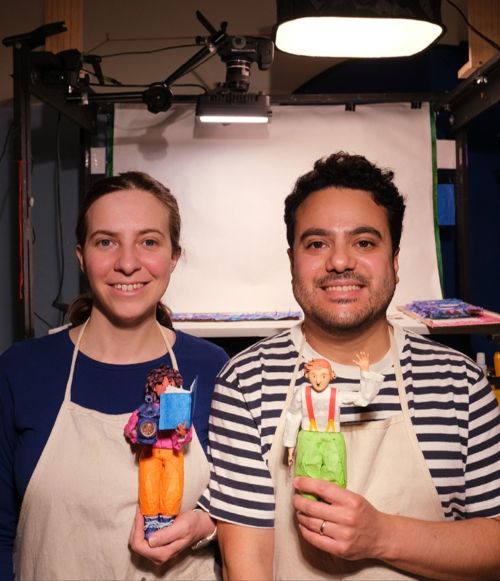
Eleanor Evans and Giovanni Aguilar are Canberra based artists and animators working in intricately handcrafted stop motion animation. Key to their collaboration is bringing together their different skills, with Eleanor’s work in experimental animation and Giovanni’s experience as a graphic designer and musician.
Eleanor and Giovanni met in 2016 while studying a master of stop motion animation at BAU College of Arts & Design of Barcelona. Since that time, they have worked together on more than 15 animated music videos and short films which have screened worldwide in film festivals, as well as animated musical segments that have appeared on Nick Jr and SBS.
About Adam Deuisen
Adam Deuisen is a live-performance and festival director with over 15 years of experience as both an independent artist, and a programmer and presenter. He is a graduate of Charles Sturt University MA - Directing for the Stage, and in 2018, graduated as part of NIDA’s inaugural cohort of the MFA – Cultural Leadership.
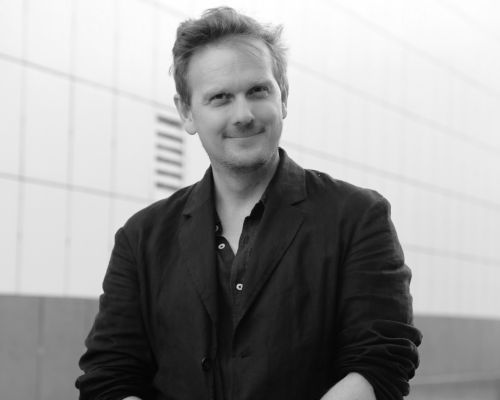
He has also worked as Artistic Director of Regional Arts Festival Artstate, Associate Artist at Bathurst Memorial Entertainment Centre, Manager of New Work and Sector Development at Canberra Theatre Centre, Head of Programming for FYI Canberra and Creative Producer for New Annual, Newcastle.
Adam is the current Creative Director of Canberra’s Enlighten Festival. A celebration of art, culture and entertainment bringing together some of Australia’s National Cultural Institutions for 11 days in the capital.

 Assistance animals welcome

 Hearing induction loop

 Wheelchair accessible
Visit us
Find our opening times, get directions, join a tour, or dine and shop with us.