
Hallyu and the Oryun Haengsil
A little-known part of our work at the Library sees us loan items from our collections to other libraries, museums, archives and galleries, both in Australia and around the world, to support their exhibition programs. Similarly, the Library also borrows material from other cultural institutions for inclusion in its own exhibitions. Loans to other institutions, known as outward loans, enable us to learn more about our vast collection while improving access to it in-person and online.
Hallyu! The Korean Wave
From November 2025, the Library is lending Volume 1 of 4 of the Oryun Haengsil to the National Museum of Australia (NMA) in Canberra for an exhibition titled Hallyu! The Korean Wave.
Hallyu! was developed by the Victoria and Albert Museum, a leading decorative arts and design museum in London, and opened to the public in 2023. The exhibition explores and celebrates the rise of South Korean pop culture and its impact on global cinema, drama, music, beauty and fashion. Examples include PSY’s viral song Gangnam Style (2012), the Oscar-winning film Parasite (2019) and the hit series Squid Game (2021). The NMA is the exhibition’s first and only destination in the Southern Hemisphere on its world tour.

The Oryun Haengsil being packed for transport by a NMA conservator.
The Oryun Haengsil being packed for transport by a NMA conservator.
The Library carefully considers each formal loan request received from other institutions, and once approval has been granted, it must pass through many hands before it can safely leave the building. The material is valued for insurance purposes, condition checked by conservators to determine if it can be displayed and transported safely, and then packed by object preparators. An agreement outlining the requirements of the loan is also signed by the lending and borrowing institutions. The whole process is coordinated by collection-management professionals, known as registrars.
The rare book requested
The Oryun Haengsil, also commonly titled the Oryun Haengsilto, was created in 1797 from a compilation of two other texts: Samgang haengsilto, compiled 1432, and the Iryun haengsilto, compiled 1518. These texts discuss foundational relationships of Confucian philosophy and comprise over 100 biographies which exemplify Confucian morality and values.

The Library’s four Oryun Haengsil volumes, nla.obj-3925957800. Printed on mulberry fibre paper using carbon-based ink with side-stich binding.
The Library’s four Oryun Haengsil volumes, nla.obj-3925957800. Printed on mulberry fibre paper using carbon-based ink with side-stich binding.
The combined Oryun Haengsil, with text in Traditional Chinese, translations in Korean Hangul, and images, is intended to make its Confucian stories of piety and loyalty as accessible as possible to a late Joseon period audience. King Chŏngjo (1752 –1800), who ordered its creation, strongly promoted Neo-Confucian values and was an instrumental figure in the renewal of the Joseon era. His notable reforms also included the establishment of the royal library Kyujanggak.
The 4 volumes of the Oryun Haengsil emphasise several core Confucian relationships, including fathers and sons, kings and subjects, and husbands and wives, as well as between friends, brothers, clan members and teachers and students.
Our copy of the Oryun Haengsil is part of the McLaren-Human Collection, a large collection of Korean, Japanese and Chinese texts donated by Jessie McLaren in 1984.

The page featuring an illustration of a traditional Confucian story of filial piety on display at Hallyu! The Korean Wave. Oryun Haengsil, Volume 1, Image 163,
nla.obj-3925957800.
The page featuring an illustration of a traditional Confucian story of filial piety on display at Hallyu! The Korean Wave. Oryun Haengsil, Volume 1, Image 163,
nla.obj-3925957800.
One small sentence, a world of mystery
Previous records noted that our version was the first edition from 1797. While researching in preparation to loan the item, we discovered a comment in another edition which raised further questions.
In the version of the Oryun Haengsil held by the Asami Library – an 1859 reproduction of the 1797 original – King Ch'ŏljong (1849 -1864) suggests that the original 1797 edition is rare due to an event which motivated the 1859 reproduction.
The reproduction was necessitated by the fact that all printed copies of the 1797 edition had been destroyed by fire in 1857.
Although some 1797 editions still survive in institutions such as the National Library of Korea, more research was needed to confirm the rarity and age of our copy.
Further investigation identified that our copy of Volume 1 had a foreword from Kim Pyŏng-hak (1821–1879). This foreword, dated the tenth year of King Ch'ŏljong’s reign, confirmed that our copy was a version of the 1859 reproduction.

The final page of Kim Pyŏng-hak’s foreword, including his name (金炳學). Oryun Haengsil, Volume 1, Image 10, nla.obj-3925957800.
The final page of Kim Pyŏng-hak’s foreword, including his name (金炳學). Oryun Haengsil, Volume 1, Image 10, nla.obj-3925957800.
Our catalogue is always evolving as we learn more about the rare and unique items in our collection, including the Oryun Haengsil. There’s more to learn about the various editions of the Oryun Haengsil, as an identical copy has yet to be identified in another institution. The catalogue provides a mechanism for researchers and members of the public to suggest further information.
See and read the book
Our research on the Oryun Haengsil has now been re-purposed to enhance its description in our online catalogue. All 4 volumes were also digitised and are now available online via Trove. These improvements to online access situate our copy within a global collection of digitised Oryun Haengsil volumes held by the Library of Congress, Waseda University, Kyoto University, and the University of California Berkeley Library.
At the NMA, the Library’s copy of the Oryun Haengsil will be featured in a display exploring the global reception of Korean television and cinema, and the depiction of ancient belief systems in popular K-dramas. You can see this rare book in person at the NMA until 10 May 2026. If you cannot travel to Canberra to see the exhibition in-person, we invite you to browse the digital copies on Trove.

The Oryun Haengsil on display in Hallyu! The Korean Wave at the National Museum of Australia.
The Oryun Haengsil on display in Hallyu! The Korean Wave at the National Museum of Australia.
More to explore

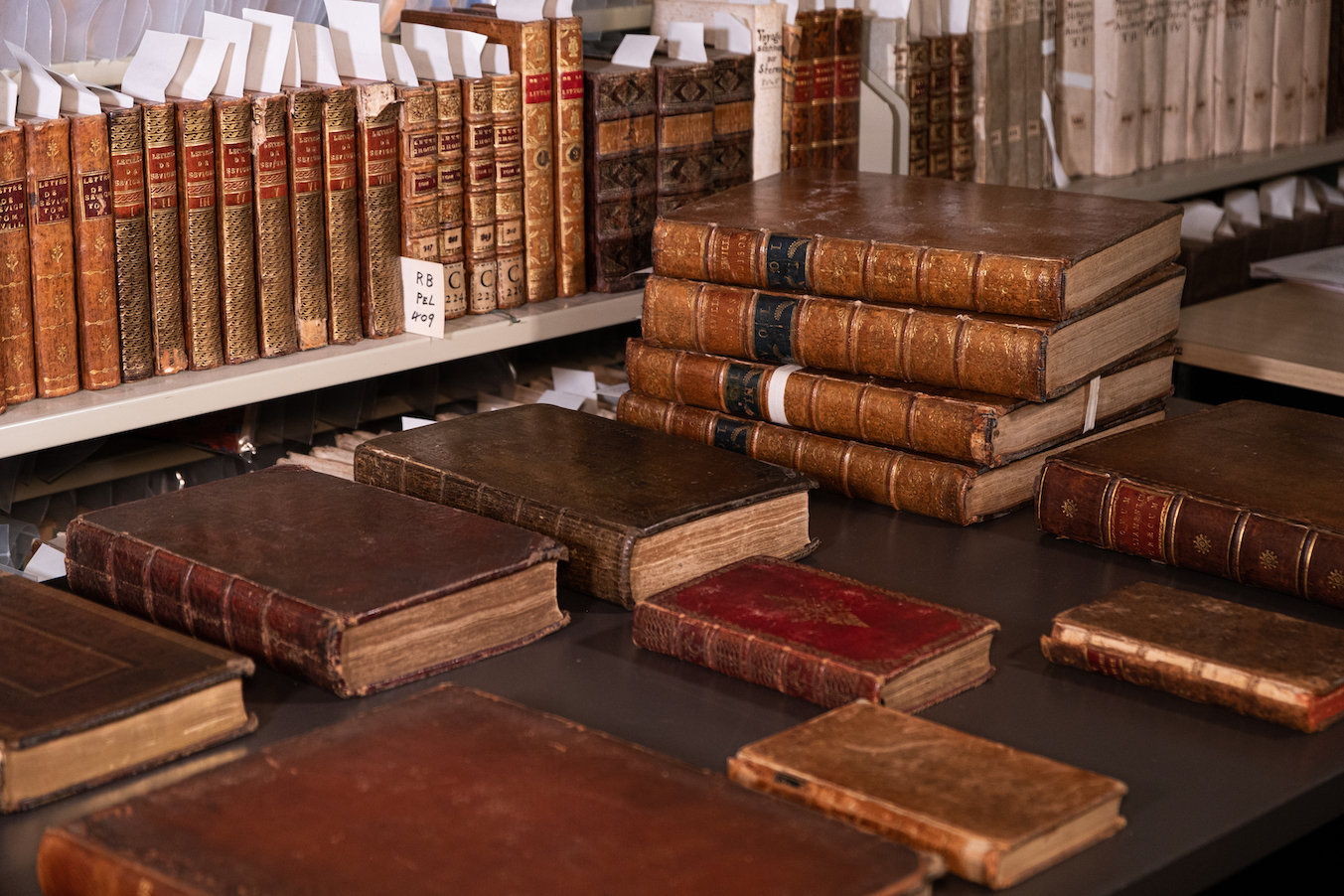

National Library of Australia Treasures Gallery.
Visit us
Find our opening times, get directions, join a tour, or dine and shop with us.