

New book, Wangka Wakaṉutja: The Story of the Papunya Literature Production Centre
- Book tells the definitive story of a radical bilingual literature movement
- Book and major exhibition at the National Library launch in April
- Explores the remarkable literary and artistic significance of Papunya
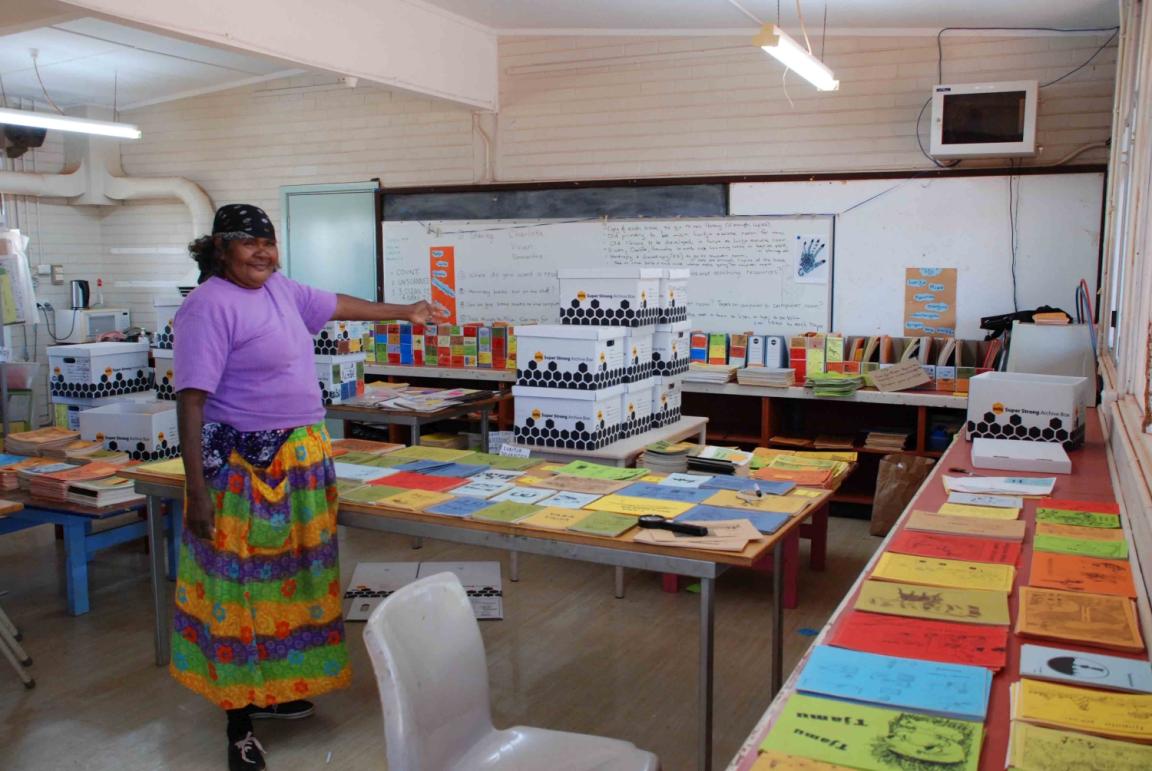
Vivien Johnson, Charlotte Phillipus in the Papunya School’s Luritja Piipa in May 2010, courtesy of the photographer.
Vivien Johnson, Charlotte Phillipus in the Papunya School’s Luritja Piipa in May 2010, courtesy of the photographer.
In April, the National Library of Australia will launch an important new book and major exhibition telling the story of the remarkable literary and artistic output of the Papunya Literature Production Centre.
Papunya is a remote Aboriginal community in the Western Desert region of the Northern Territory, and the birthplace of the internationally known Western Desert art movement. Between 1979 and 1990, the Papunya Literature Production Centre produced hundreds of Pintupi-Luritja bilingual readers guided by the community’s Elders, among them pioneers of the Western Desert Art movement.
The readers – illustrated books – were produced as literacy tools for local schoolchildren and tell stories of first contact, Dreamings, community life, plants, animals and more. Some are wildly creative and many are full of humour. Others are moving, dramatic and extraordinary. Together, they form a living record of an Indigenous language, safeguarding the knowledge and stories contained within them for future generations.
The book which records this incredible work, Wangka Wakaṉutja: The Story of the Papunya Literature Production Centre, is written by Vivien Johnson, Charlotte Phillipus and Samantha Disbray. It tells the complete story of the beginning of the literacy movement in Papunya through the development and prolific work of the Papunya Literature Production Centre, and the eventual end of the program that saw much of the material packed away. It also includes interviews, art and stories by the authors and artists who worked at the Literature Production Centre and features fully illustrated recreations of several readers in Pintupi-Luritja language. The recreations are printed on different paper stock to provide a genuine tactile experience for the reader.
The exhibition of the same name features stories, drawings, photographs, manuscripts, ephemera and oral histories from the collections of the Papunya community, Papunya School, National Library of Australia, Australian National University, and other private collections, building on a recent exhibition shown in Darwin.
Old stories and new stories. For people (Aṉangu) to gather stories, put them on tapes, we would translate them, all those old stories. Scary stories, hunting stories, stories about everything, we were collecting them, translating and recording them together alongside pictures. There were lots of us working at the literacy program, ladies and men some drawing and some collecting stories.
Professor Vivien Johnson, lead author of the book, exhibition advisor and sociologist, was awarded a National Library of Australia Literary Fellowship in 2019. Her catalogue of the 250 Papunya readers in the Library’s collection provided valuable content for the book and exhibition.
That morning in late 2009 when the darkroom door was opened, I happened to be in the surrounding classroom that was once the beating heart of the Papunya Literature Production Centre...I quickly realised that something marvellous had been stuffed away in those cardboard boxes piled high against the walls: Papunya’s stories in its own words and images. The extraordinary body of literature created by Papunya’s first literate generation is an achievement in its own way as revolutionary as their fathers’ transmutation of a traditional visual language into the medium of Art.
Alongside the story of Papunya, its books and their creators is the remarkable education and publishing movements set in motion by the 1970’s NT Bilingual Education program. It’s small publishing houses in schools produced books in dozens of Aboriginal languages. Wangka Wakaṉutja places the Papunya Literature Production Centre in this education, art and literary history.
“Wangka Wakaṉutja” is Pintupi-Luritja for “the story has been told”, which is a fitting title for a project that honours the voices, histories and creative legacy of the Papunya community. It has been a privilege to continue working with members of the Papunya community, bringing First Nations stories to more people across Australia and around the world.
Thanks to the generosity of an anonymous Library Patron and in consultation with the community, over 350 publications from the Library’s collections were digitised and are now freely available online via Trove.
Wangka Wakanutja: The Story of the Papunya Literature Production Centre is available for pre-order now and will be available in bookstores from Wednesday 1 April.
The exhibition opens at 9am on Saturday 4 April at the National Library of Australia in Canberra. Entry to the exhibition gallery is free, no bookings required.
Media kit
Images for media use available for download via Dropbox
About Fellowships and Scholarships
Media enquiries
Georgia McDonald, Media Liaison, National Library of Australia
Phone: 0401 226 697
Email: media@nla.gov.au
Visit us
Find our opening times, get directions, join a tour, or dine and shop with us.