

Poetry and empire in Antarctica
Antarctica is often conceptualised as a testing ground for masculine endeavour. The most famous stories of the continent’s history hinge on the struggling white male body. We find these bodies tragic in defeat, like Scott and his polar party, or heroic in their sheer determination to survive, as with the men of Shackleton’s Endurance or Douglas Mawson’s gruelling solo trek back to safety.
While I am not immune to the appeal of these stories, as a poet and researcher I am keen in my creative and critical work to contribute to an ongoing interrogation of popular preconceptions of the history of the Antarctic continent. My own way into these conversations is through poetry, writing my own work as well as analysing uses of poetry on historic expeditions. One of the great advantages of poetry as a genre is its ability to hold competing ideas in tension. My aim in writing about Antarctic history is to pull together strands of explorers’ pre- and post-expedition lives to challenge the idea of Antarctica as separate from, and untainted by the outside world.

Branwell Roberts, 2026 National Library of Australia Scholar
Branwell Roberts, 2026 National Library of Australia Scholar
Poetry and Antarctic entertainment
Both writing poetry and writing about poetry brought me to the Papers of Thomas Griffith Taylor. Taylor was the senior geologist on the 1910-1913 Terra Nova expedition to Antarctica, a compulsive recorder of events and hoarder of ephemera. It had become apparent early on in my research that this could be a rich seam of information about expedition reading practices. I was fortunate as a recipient of the 2026 National Library of Australia Scholarship to be able to spend four weeks with this material.
Taylor’s writings, both published and unpublished, had already been an important source for my research. Far more so than some of his colleagues, Taylor was determined to record extensively the minutiae of everyday expedition life. Irrepressibly optimistic in outlook, as evidenced by the title of his book about the expedition With Scott: the silver lining, Taylor was keen to document the social side of Antarctic life. This preoccupation can be seen throughout his Antarctic writings but is perhaps most vividly realised in a scrapbook bound in expedition packing cases.
This volume contains all manner of ephemera pertaining to Terra Nova and earlier explorations of the continent, including unbound pages from the Aurora Australis (the first book printed in Antarctica), records of lecture programs and spelling competitions held during the dark winter months, originals of articles for the expedition newspaper, and caricatures by marine biologist Denis Gascoigne Lillie recording raucous social life on the expedition ship.

Quiet Sunday Evening on the Terra Nova (caricature sketch) by Denis Gascoigne Lillie, Thomas Griffith Taylor, Papers of Thomas Griffith Taylor, 1880-1963, National Library of Australia, nla.cat-vn2961870
Quiet Sunday Evening on the Terra Nova (caricature sketch) by Denis Gascoigne Lillie, Thomas Griffith Taylor, Papers of Thomas Griffith Taylor, 1880-1963, National Library of Australia, nla.cat-vn2961870

Scrapbook mounting the Quiet Sunday Evening on the Terra Nova (caricature sketch) by Denis Gascoigne Lillie, Thomas Griffith Taylor, Papers of Thomas Griffith Taylor, 1880-1963, National Library of Australia, nla.cat-vn2961870
Scrapbook mounting the Quiet Sunday Evening on the Terra Nova (caricature sketch) by Denis Gascoigne Lillie, Thomas Griffith Taylor, Papers of Thomas Griffith Taylor, 1880-1963, National Library of Australia, nla.cat-vn2961870

Unbound page from Aurora Australis, Thomas Griffith Taylor, Papers of Thomas Griffith Taylor, 1880-1963, National Library of Australia, nla.cat-vn2961870
Unbound page from Aurora Australis, Thomas Griffith Taylor, Papers of Thomas Griffith Taylor, 1880-1963, National Library of Australia, nla.cat-vn2961870
The leader of the Terra Nova expedition, Robert Falcon Scott, also led the 1901-1904 Discovery expedition. The Terra Nova expedition utilised some of the same structures as the men of Discovery, and shared some personnel, most notably Edward Adrian Wilson and Edgar “Taff” Evans, who both perished with Scott on his return from the South Pole. It shared something else as well, the presence of a midwinter poetry debate concerning the same two poets. On 8 March 1902, two officers on the Discovery, Ernest Shackleton and Louis Bernacchi, had debated the merits of, respectively, Robert Browning and Alfred Tennyson – two giants of English poetry in the Victorian age. Similarly, Taylor’s published work records:
...a great discussion on Tennyson and Browning, during the first sledging season, as well as a follow up discussion with his fellow Australian geologist, Frank Debenham.
I had gone into the archives with the assumption that this was, at least to some extent, a direct imitation of the men on Discovery. Albert Armitage, one of Discovery’s officers had published an account of the original debate in his Two Years in the Antarctic (1905) and it was far from unusual for expeditioners heading south to consult the accounts of earlier voyages. However, it is evident from Taylor’s papers that his fondness for Robert Browning significantly predated the expedition and persisted throughout his life. Furthermore, the collection provides evidence of the ways in which Taylor’s taste in literature was utilised in his conception of national and personal identity. For example, in letters home to Australia, Taylor recounts his 1909 European travels in meticulous detail. On visiting the Rialto in Venice, specifically to see where Browning died, Taylor writes:
I was thinking of the death of Stevenson, whose house is now the German Governor’s at Samoa, and lo & behold a German was peacefully smoking his long fat pipe on Browning’s Palace as if he owned it.
A connection to Englishness through its literature here translates into a sense of entitlement to a place, on the scale of the colonial regime and the domestic dwelling.
A troubling legacy
Taylor’s archive often recounts the same incidents across genres and decades - letters, speeches and autobiography. This reiterative quality congeals into a potent reminder of the continuity between imperial expeditions in the Antarctic and colonial projects in Australia. Taylor devoted much of his post-Antarctic career to the promotion of geography as a discipline at the universities of Sydney, Chicago and Toronto.
However, this was a geography enmeshed in contemporary discourses of race science and concerned with grouping humans into different races and determining their position in a hierarchy. In Taylor’s archive cheerful letters from former sledge-mates in Antarctica co-exist alongside similarly warm correspondence with colleagues including the eugenicist Ellsworth Huntington and Isaiah Bowman, President of Johns Hopkins University and prominent anti-Semite.
To explore all the implications and complications of such an archive is beyond the capabilities of any one researcher. My hope is that with the forthcoming digitisation of the Library’s Antarctic collections, Taylor’s Australian work will attract wider critical attention from scholars across backgrounds and disciplines.
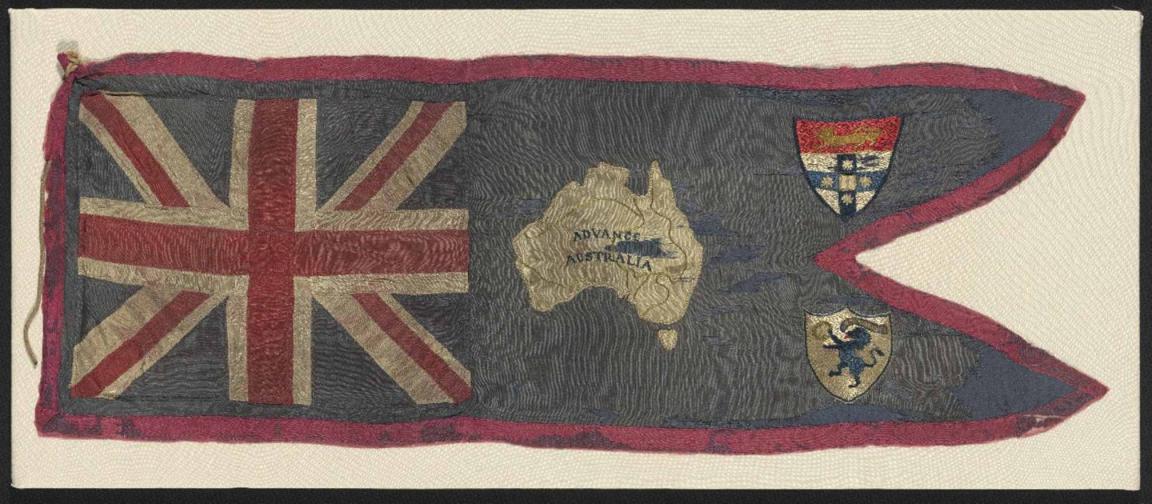
Thomas Griffith Taylor's sledging flag, 1880 - 1963, Papers of Thomas Griffith Taylor, National Library of Australia, nla.cat-vn2961870
Impacts of the archives
I knew from the outset that my critical work would benefit immensely from time at the Library, and my exegesis has been enriched by my encounter with Taylor’s archive, providing deeper understanding of the relationship between science, literature, and imperial masculine self-fashioning. However, my creative work has been transformed just as much - if not more so.
When I began my PhD, I intended to write primarily about explorers who died in Antarctica. However, it has become increasingly important to me to consider the lives of these men both before and after their time on the Antarctic continent, and so to represent their continuing engagement with a white imperial masculinity. As such, I will be devoting a sequence of poems to the two geological parties led by Taylor on the Terra Nova expedition and am experimenting with ways to represent time such that the pasts and futures of the men involved can be folded into the present of the expedition.
Antarctic history is much mythologised - not for nothing is my period of study known as the 'Heroic Age.' It is vital to represent the tension between the seemingly isolated world of the expedition and the wider context of society. Only by examining the contradictions of our fascination with Antarctica, we understand what the continent means not just to each of us individually, but to us all.
Branwell Roberts is a 2026 National Library of Australia Scholar, supported by Dr Michael Martin and Ms Elizabeth Popovski.
More to explore


Felicity Jenkins, Expeditioners form a line on the sea ice off Davis Station to farewell the Aurora Australis and wintering expeditioners returning home, Antarctica, 1998, nla.obj-144071241
