
First Australians’ contributions to early Australian science
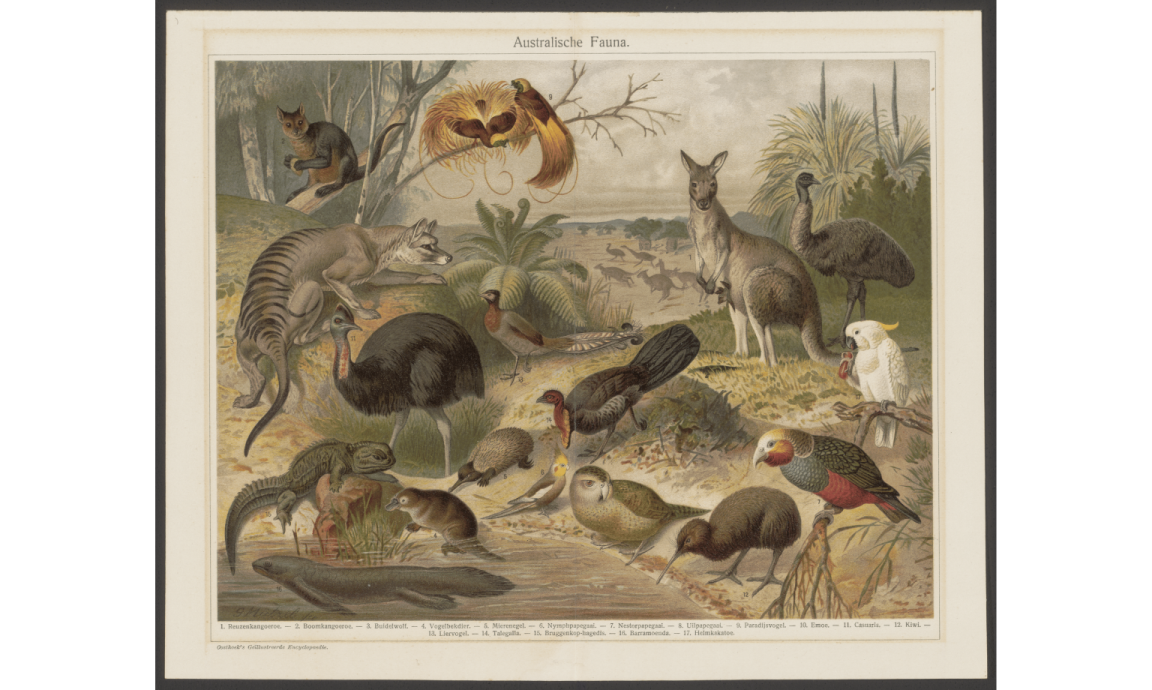
Gustav Mutzel, Australische fauna, c1880s. https://nla.gov.au/nla.obj-136360975
Gustav Mutzel, Australische fauna, c1880s. https://nla.gov.au/nla.obj-136360975
First Nations people significantly contributed to early European naturalist studies of Australian animals by sharing their deep knowledge of the local fauna and environment. This knowledge, gained over millennia of living on Country, included identifying and understanding the habits of various animals, as well as providing crucial assistance with collecting specimens and understanding animal behaviour. The knowledge of Aboriginal and Torres Strait Islander peoples also includes how these animals lived and survived in Australian environments.
Despite the significant contributions of First Nations people, their expertise was often undervalued or ignored by early European naturalists. There has been a growing effort to acknowledge and celebrate Aboriginal and Torres Strait Islander peoples’ crucial role in improving everyone’s understanding of Australian fauna and to recognise the importance of traditional ecological knowledge.
When developing a teaching and learning program suitable for your school’s local context, refer to the FIRST framework to support engagement with First Australian communities and align with the Australian Curriculum. This framework is designed to help educators build meaningful relationships with their local community and ensures learning activities are authentic and culturally respectful.
Peculiar Parents features Wiradjuri, Gamilaraay Yuwaalaraay, Dhurag and Arrernte language words for a selection of animal names. Other languages may also have names for these species.
- Encourage students to try to learn the First Nations language names for animals that live near you.
- Connect with local Community to discover how First Nations are caring for Country
- Take a senses walk on Country and see which animals and plants students can see and hear. How can students help look after the environment around them?
More to explore