
Digital Classroom | National Library of Australia (NLA)

Digital Classroom

Explore Australia's history at the National Library's Digital Classroom, aligned with the Australian Curriculum. With over 10 million items, we support diverse learning styles, fostering inquiry-based learning for students to analyse sources and draw conclusions about the Australian story.
Showing 1 - 12 of 19 results
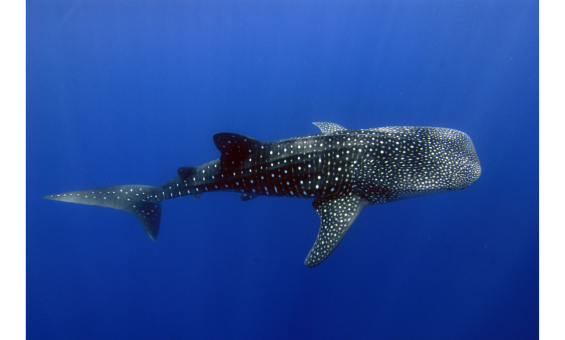
A photograph of a Whale Shark (black with white spots), swimming underwater, Copyright Commonwealth of Australia (Reef Authority).
K. Hoppen, Whale Shark, 2008. Copyright Commonwealth of Australia (Reef Authority).

Using science research to aid conservation

Topic
This topic uses an oral history interview with Bradley Norman talk about his research into Whale Sharks, particularly in reference to observations, data and evidence.

Science
Year 3
Year 4
Year 5
Year 6
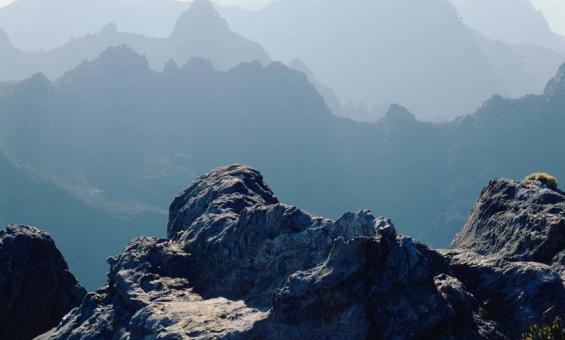
A sweeping landscape of a mountain range. The mountains are craggy and rocky. They are covered in mist.

Peter Dombrovskis, Frankland Range, Southwest National Park, Tasmania, 1995, nla.gov.au/nla.obj-150007802
Understanding the living world

Module

Explore the connections between living things, the environments they inhabit, and the forces that shape them. 

Science
Year 4
Environment and biodiversity
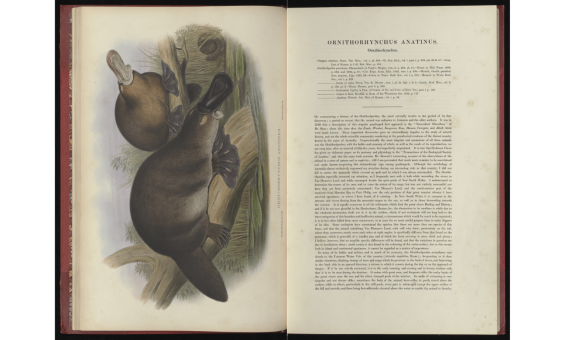
An image of an open book, with the left page featuring a full-page hand drawn colour image of two platypus from 1863 and the right page featuring a large block of text.

John Gould and Henry Constantine Richter, The mammals of Australia, 1863. http://nla.gov.au/nla.obj-2334463667
The Platypus Mystery

Topic
This topic encourages students to research why European naturalists and scientists first thought the platypus was a faked animal.

Science
Year 3
Year 4
Year 5
Year 6
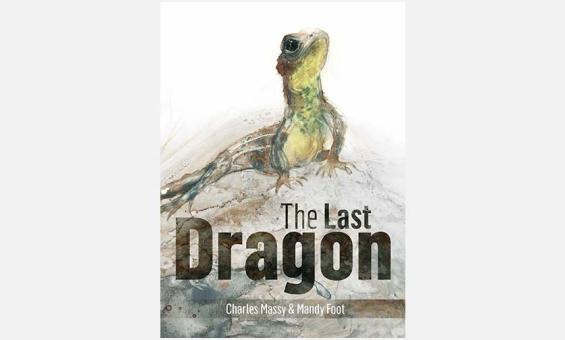
Cover of the book 'The Last Dragon'

Charles Massy & Mandy Foot, The last dragon, 2021, nla.gov.au/nla.cat-vn8612818

The Last Dragon

Topic

The Last Dragon, written by Charles Massy and illustrated by Mandy Foot, is the story of a small, rarely seen lizard, Timpo, who is the last of his kind in his valley. Convinced he is not the only Monaro grassland earless dragon left, Timpo and his companion Wolfie the spider set off across the windswept Monaro plains in search of others.

Science
Year 4
Environment and biodiversity
A sepia image of a weather almanac for 1894.

New South Wales weather almanac for ... : a general handbook for the year, 1894, nla.gov.au/nla.obj-406743496
Recording weather

Topic

In colonial Australia, there was a useful household book called an almanac. It contained lots of information, including weather forecasts and pictures of the flags used to signify approaching storms.

Humanities
Science
Year 4
Year 5
Year 6
Environment and biodiversity
Geography
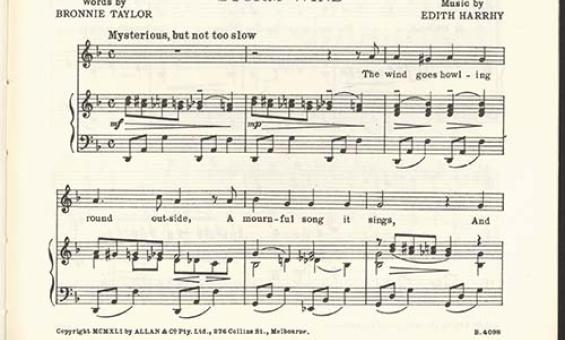
Sheet music featuring an illustration of a child looking out an open window

Edith Harrhy and Bronnie Taylor, Songs for young Australians [music] / words by Bronnie Taylor ; music by Edith Harrhy, 1941, nla.gov.au/nla.obj-175231656
Presenting weather

Topic

The weather is an important part of our lives, and this is reflected in the arts and other sources we consume.

Humanities
Science
Year 4
Year 5
Year 6
Environment and biodiversity
Geography
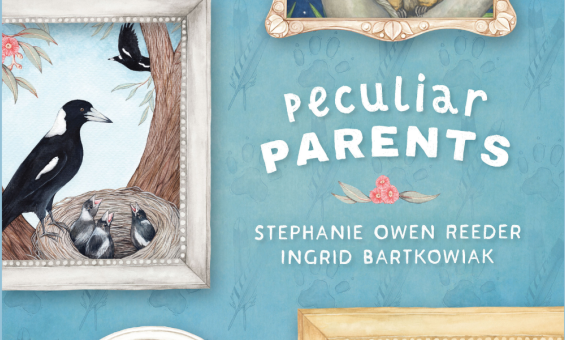
Cover for 'Peculiar Parents' by Stephanie Owen Reeder and illustrated by Ingrid Bartkowiak, featuring illustrations of framed animal pictures on a blue background
Peculiar Parents – Nature and the Development of Science

Module
This Digital Classroom module encourages students to dive into the science behind Australia’s peculiar fauna. Aligned with Australian Curriculum: Science and Humanities and Social Sciences for Year Three to Six students, this module encourages students to develop their understanding of how scientific research development and technologies has helped aid our understanding and ability to protect unique Australian fauna.

Science
Year 3
Year 4
Year 5
Year 6
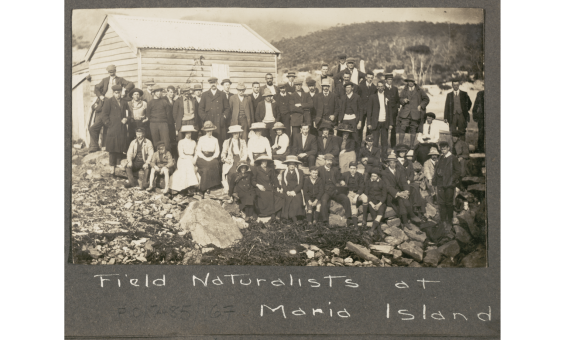
A black and white photo of a large group of men, women and children from a Tasmanian field expedition in 1912.

E.W Searle, Field naturalists at Maria Island, 1912 [Tasmania], 1912. http://nla.gov.au/nla.obj-142164875
Naturalist observations and citizen science

Topic
This topic explores the contribution of citizen science to scientific studies.

Science
Year 3
Year 4
Year 5
Year 6
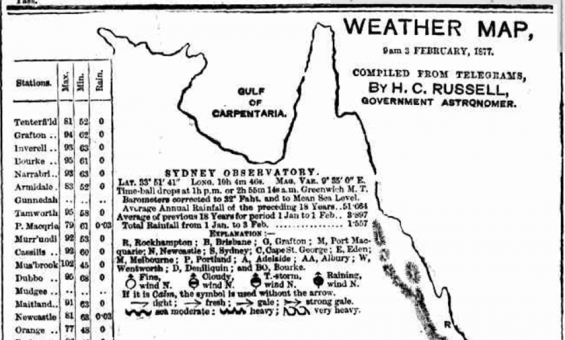
an image of a map showing an outline of the eastern half of Australia with about 30 towns down the side with their minimum and maximum temperatures.

WEATHER MAP, 9 am 3 FEBRUARY, 1877. (1877, February 5). The Sydney Morning Herald (NSW : 1842 - 1954), p. 6. nla.gov.au/nla.news-article13389140
Mapping weather

Topic

In 1877, meteorologist and astronomer Henry Russell produced the first published weather map for the colony of New South Wales.

Humanities
Science
Year 4
Year 5
Year 6
Environment and biodiversity
Geography
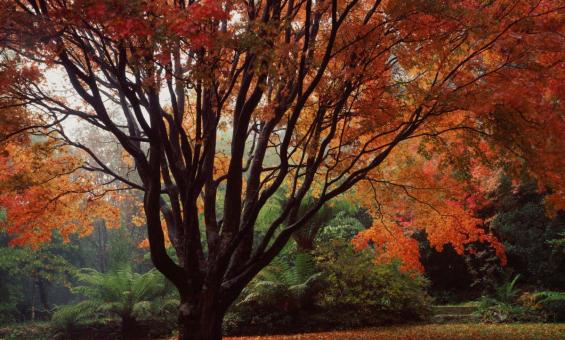
A large autumnal fern tree with a canopy that takes up most of the image. It's leaves a brilliant reds and oranges. Many leaves have fallen on the grass below. In the background many lush green ferns can be seen

Peter Dombrovskis, Acer in autumn, Dombrovskis' garden, Fern Tree, Tasmania, 1993, nla.gov.au/nla.obj-150387361
Intertwined

Topic

The Earth is inhabited by a vast number of living creatures. Some scientists believe there are around 8.7 million species of plants and animals that call our planet home. These living creatures exist in almost every corner of our world with only the most barren of deserts and deepest of oceans remaining unpopulated save for microscopic organisms.

Science
Year 4
Environment and biodiversity
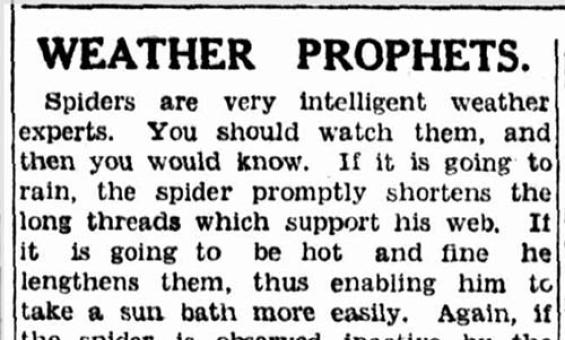
Clipping of a newspaper article titled 'Weather Prophets'.

WEATHER PROPHETS, The Age (Melbourne, Vic. : 1854 - 1954), p. 17, 4 November 1937 nla.gov.au/nla.news-article205560442
Forecasting weather

Topic

As cub reporter Betty Wilson (aged nine in 1937) tells us, forecasting the weather is not all about maps and laboratory science!

Humanities
Science
Year 4
Year 5
Year 6
Environment and biodiversity
Geography
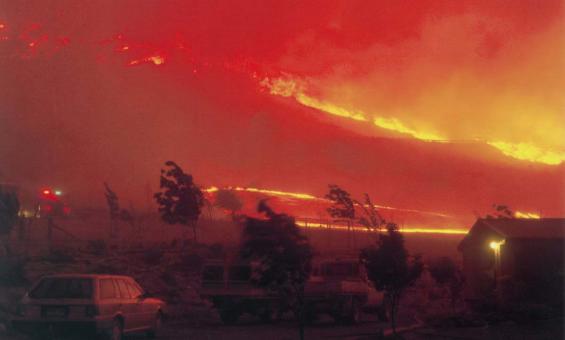
A scene of a hillside completely ablaze. A large fire front is moving up the hillside. The image is blanketed with smoke. The lights of a fire engine can be seen through the smoke. A station wagon is parked in the forground.

Cutting, Jeff, 1945-. (2003). Freshening north-westerly winds drove the Stockyard fire down Apollo Road onto Ballineen in the hour before midnight on 17th January 2003. [picture] / Jeff Cutting. nla.gov.au/nla.obj-149584789

Forces of nature

Topic

The Earth and its environments are constantly changing. For millions of years, the wind has shaped and eroded mountains and sand dunes; the constant crashing of waves has changed and sculpted the coastline; and drought and fire have charred and renewed bushland. This process is ongoing and is a natural part of life.

Science
Year 4
Environment and biodiversity

Need help?

Our librarians are here to guide you.

Ask a librarian