

Collection deaccessioning and disposal policy
1. Purpose
The aim of this policy is to provide a clear framework to effectively manage the deaccessioning and disposal of collection material and the disposal of material not selected for the collection. This framework aims to ensure:
- compliance with the Library’s legislative and regulatory framework
- alignment with the National Library’s Accountable Authority Instructions, Financial Management Authorisation, Asset Management Policy and related procedures
- clarity about responsibilities for approving deaccessioning and disposal activities
- guidance on criteria to support selection decision-making and accountability through outlining reporting mechanisms for deaccessioning and disposal activities.
2. Scope
This policy applies to the selection, deaccessioning and disposal of all collection material, as well as the disposal of material not selected for the collection, and supersedes all previous procedures and guidelines.
This policy is in alignment with the functions of the National Library as set out in section 6 of the National Library Act 1960 (Cth) (the Act), and section 7(2)(b) of same, which provides that the Library has the power to “dispose of, lend or hire out library material and other goods the property of the Library”.
In addition, section 25 of the Act provides that each of the Library’s annual reports made under the Public Governance, Performance and Accountability Act 2013 (Cth) (PGPA Act) must include a statement relating to disposals of library material during the relevant reporting period.
In accordance with the PGPA Act, the proper use and management of assets is the responsibility of all Commonwealth officials. The Asset Management Policy enables compliance with the Commonwealth financial framework and applies to the management of all assets including collection assets.
3. Definitions
| Term | Definition |
|---|---|
| Collection material | Library material that has been formally accepted into the Library’s collection (accessioned) and meets the definition of an ‘asset’ under the Asset Management Policy. This term is inclusive of any items, including those that may fall outside the definition of Library material, which have been accepted into the collection. |
| Collection asset | The Asset Management Policy defines assets in the Library context, including the asset classes which are relevant to the Collection. These cover collections which are physical, digital and digitised, being: heritage and cultural (national collections) and collection intangibles (intangible collections). |
| Curatorial guidlines | For the purposes of this policy, curatorial guidelines (including selection guidelines) refer to documents that provide staff with a clear and documented decision-making and approval path that supports selection, deaccession and disposal actions. Guidelines must also comply with the National Library’s current Financial Management Authorisation. |
| Deaccessioning | The process of formally removing collection material from the collection. Deaccessioning may involve several steps including deselection, gaining approvals and, where required, reflecting the decision to deaccession material through adjustment to the Library’s catalogue and/or finding aids. This may include suppressing the record in the public catalogue. |
| Deselection | Process of identifying material that has been previously accessioned into the collection to be deaccessioned. For the purposes of this policy, deselection is part of the deaccessioning process. |
| Disposal | Refers to both:
Disposal will be undertaken in accordance with the disposal principles and methods outlined in the Asset Management Policy. |
| Ethical collection management | The Library maintains a collection in line with its statutory role of maintaining and developing a national collection of library material, including a comprehensive collection of library material relating to Australia and the Australian people. The Library does not and will not make collection management decisions for commercial purposes. The Library exercises best possible ethical and professional practice and judgement in collecting cultural materials, including respect for the enduring rights of creators including the rights of Indigenous peoples to control their own cultural and intellectual property. The Library undertakes appropriate due diligence and is accountable and transparent in its acquisition of materials by legal deposit, purchase or donation. The Library complies with Commonwealth public governance, performance and accountability rules and collection principles are articulated in publicly available documents such as the Strategic Vision, Collecting Strategy and Collection Development Policy. The Library ensures cultural materials have been legally exported from their country of origin and any intermediate countries. The Library does not acquire materials where there is suspicion they were obtained through unauthorised means. The Library reviews new information about an item in the institution’s collection and undertakes further investigations, if required. Collecting decisions also consider the environmental impact and lifecycle costs of the growing collection. |
| ICIP | Indigenous Cultural and Intellectual Property (ICIP), as defined in the National Library of Australia’s ICIP Protocol. |
| Library material | Defined by section 4 of the Act to include books, periodicals, newspapers, manuscripts, films, sound recordings, musical scores, maps, plans, pictures, photographs, prints and other recorded material, whether in writing or in some other form. This term includes all Library material, including collection and non-collection material, in physical and digital forms. |
| NED | National edeposit; an online service for the deposit, management, discovery, delivery and preservation of published electronic (digital) material across Australia. |
| Non-collection material | Library material that has not been formally accepted into the Library’s collection but is in the possession or control of the Library (for example, material donated by individuals without prior Library agreement to receive and accept the material). Materials that may not be selected for addition to the collection are:
|
| Secret/sacred | Materials created by or relating to First Nations Australians that are not appropriate to be shared publicly or may be subject to customary laws or other restrictions, as defined in the ICIP Protocol. |
| Selection | The decision to accept or reject material that has been sent to the Library for inclusion in the collection. |
4. Policy statement
4.1.1 The Library recognises that selection, deaccessioning and disposal of collection material is an integral part of building and shaping the collection and of sound collection management.
4.1.2 This policy outlines selection, deaccessioning and disposal pathways for both accessioned collection assets and for materials sent to the Library for consideration for inclusion in the collection.
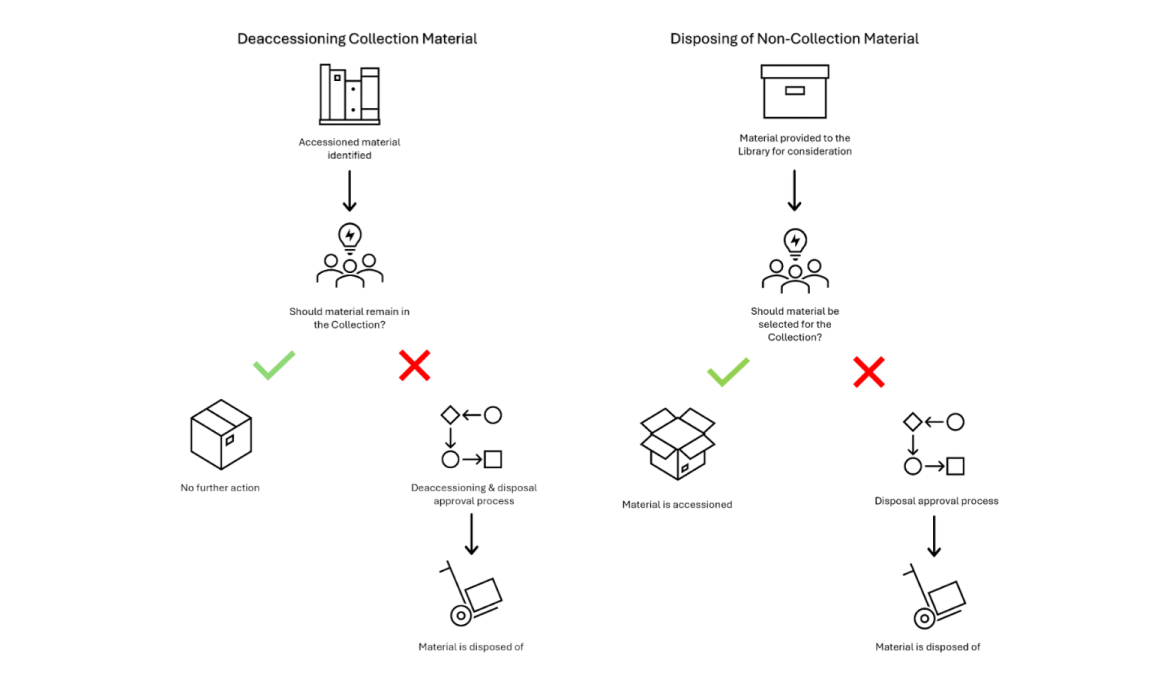
4.2. Deaccessioning collection material - considerations
4.2.1 Deaccessioning decision-making and the associated approvals and disposal processes must consider:
- alignment of the Library material with the Collection Development Policy and Collecting Strategy
- the cultural significance of the Library material if created by or referring to Australia’s First Nations peoples, particularly material that contains ICIP and/or is considered secret/sacred or otherwise sensitive
- whether the material is unique or uniquely held by the Library
- ease of access to the same material via national or international services
- the cultural significance and sensitivity of the material for Australian communities
- the research value of the material
- the monetary value of the material
- any legal or regulatory obligations that may prevent or require deaccessioning, or deaccessioning within a certain period
- whether the material relates to individuals or groups with a strong relationship to the Library
- the level and type of risk, and alignment of this risk with the Library’s risk appetite, associated with a decision to deaccession and dispose of the Library material
- the requirement for additional or specialist expertise to fully assess the implications of the deaccession and disposal, such as instances where specific language skills or specific in-depth subject knowledge are required.
4.2.2. In addition to the factors listed above, decisions to deaccession and dispose of material from the Library’s collection may be based on the following factors, applied individually or in combination:
- The usability of the material, through physical damage, file corruption, or format obsolescence
- hazards which cannot be controlled in a cost-effective manner
whether the material is a duplicate not required for access or preservation purposes - whether the material is freely available online or in digital form
- whether the material has been accepted into the collection through error
- whether the material was included in an acquisition that the donor or vendor did not intend to include or did not have the legal right to transfer to the Library
- whether the material has been missing for 2 years or more or is known to have been removed from the collection without having been deaccessioned
- whether the proposed deaccessioning and disposal of collection material is large scale.
4.2.3. Unless one of the above factors at 4.2.2 applies, digitisation of a physical collection item is not, in and of itself, a criterion for deaccessioning and does not trigger a deaccession action.
4.2.4. Deaccession processes must be completed prior to any disposal action.
4.3. Deaccessioning collection material – approvals
4.3.1. The thresholds for decisions made by Library officials for the purpose of deaccessioning and disposing of collection material are outlined in the Financial Management Authorisations.
4.3.2. All proposals to deaccession collection material must be submitted to the appropriate delegate in writing and be approved prior to any deaccessioning processes commencing. All deaccessioning documentation must be completed in line with the Collection Deaccessioning and Disposal procedural guidelines.
4.3.3. All proposals to deaccession collection material must include options for the disposal of the deaccessioned material, consistent with the Disposal Principles at 4.5.1 and the Asset Management Policy.
4.3.4. When approving deaccessioning and disposal proposals, Library officials should consider whether the proposal, particularly the suggested method of disposal, involves non-financial considerations (such as reputational risk) that mean the approval should be made by a delegate at a higher classification level.
4.4. Deaccessioning collection material – governance
4.4.1. Amending Library records
4.4.1.1. Deaccessioning and disposal of collection material may necessitate the following amendments to Library systems and records:
- permanent suppression of the record and associated finding aid (if applicable) from the public catalogue and/or any other public facing discovery services, or amendment of said record and finding aid (if only part of a collection is impacted).
- removal of the record from the Australian National Bibliographic Database (if relevant).
- updating of the record in the Asset Management Register as per the Asset Management Policy.
4.4.2. Deaccessioning Record Keeping
4.4.2.1. Deaccessioning proposals and approval documentation are Library records and must be retained in accordance with the record-keeping requirements outlined in the Archives Act 1983 (Cth).
4.4.3. Reporting of Deaccessioning and Disposal
4.4.3.1. Data regarding deaccessioning and disposal of Library material must be included in the Library’s annual report.
4.5. Disposal of deaccessioned material
4.5.1. Disposal Principles
4.5.1.1. The method for disposing of deaccessioned collection material must be consistent with the current Asset Management Policy and associated procedures. The method of disposal must be:
- in alignment with ethical collection management
- appropriate to the material being disposed of, considering:
- any sensitivies (cultural or otherwise) specific to the material
- health and safety considerations where material to be disposed of contains hazardous material
- in alignment with corporate goals, Library relationships, and collaborative arrangements
- cost-effective.
4.5.2. Disposal Methods
4.5.2.1. Approved methods for disposing of Library material, including collection material, are provided in the Asset Management Policy.
4.5.2.2. Where deaccessioned Library material is disposed of by sale, the proceeds of the sale will be put toward building and/or maintaining the Library collection.
4.5.2.3. Where Library material was gifted under the Australian Government’s Cultural Gifts Program, it cannot be returned to the donor as the donor has received the benefit of a tax deduction for the gift.
4.5.2.4. Factors to be considered when selecting a disposal method include:
- the potential for the deaccessioned collection material to enhance the collection of another Australian library, collecting institution or community archive or repository (which may include appropriate Indigenous organisations), or overseas Library or collecting institution
- whether secure disposal as opposed to sale or transfer is required due to the nature of the collection material or any agreements associated with the acquisition
- the likely sale proceeds of the collection material
- the costs associated with the disposal methods (including transport costs)
- the volume of the collection material for sale
- environmental issues and associated legislative requirements (for example, the disposal of asbestos-containing materials).
4.5.3. Disposal by Transfer/Gift – Specific Considerations
4.5.3.1. The Asset Management Policy outlines specific conditions relating to the disposal of assets by way of gift/transfer to other entities:
- When contemplating whether to authorise a gift of relevant property, a delegate must consider overarching principles that, if appropriate to do so, the asset should be:
- transferred with or without payment to another government entity within Australia (including State or Territory governments)
- transferred without payment to an educational institution.
- A departure from the Commonwealth’s overarching principles regarding disposal by gift is permitted if the relevant property in question is genuinely surplus to the entity’s requirements, and:
- is of historic or symbolic significance to the proposed recipient, including return of secret or sacred material to cultural authorities and/or to Country
- holds other specific significance for the proposed recipient and there are compelling reasons to justify its giving to that recipient
- is of low value and otherwise uneconomical to dispose of, or
- the gifting supports the achievement of an Australian Government policy objective.
- If a gift is being contemplated, the delegate is to consider whether authorising a gift in a particular case would create an onerous or undesirable precedent.
- If the gift would create that precedent, it must not be offered.
- The delegate would need publicly defensible and objective grounds to justify favouring the person or organisation with the gift, ahead of other potential recipients.
- A delegate must not exercise their authorised power without obtaining a reasonable estimate of the market value of the asset proposed to be gifted. If this is not possible, the delegate must use their discretion in assigning a notional value and must record the basis for determining the value of the asset.
- In circumstances where it is determined to be appropriate to gift deaccessioned collection assets and these assets are considered to have financial value, two independent valuations to estimate the value of the asset to be gifted will be required. This information will then be used by the Library’s Finance section to process a disposal.
- Any gift of a deaccessioned collection asset must be approved, in writing, by the Director-General or Minister.
4.5.3.2. The provisions of the Protection of Moveable Cultural Heritage Act 1986 (Cth) may apply to the transfer of items that are defined as protected objects of a foreign country or have cultural significance to Australia.
4.5.4. Disposal of Digital Collection Material – Specific Considerations
4.5.4.1. The terms of this policy apply equally to physical and digital collection materials, with the following additional considerations for digital material.
4.5.4.2. Disposal of digital collection material means rendering - through deletion, overwriting, or other appropriate mechanisms - said material irretrievable.
4.5.4.3. For the purposes of this policy, the following will not be considered deaccessioning or disposal actions and will not require curatorial selection and deselection:
- replacement of a digital item with another digital item, where the initial digital item is:
- deposited via National edeposit (NED), and is
- corrupted, or otherwise unable to be accessed through discovery services due to technical fault, or
- not the original item the depositor meant to deposit, and was deposited by mistake
- and the replacement digital item:
- is deposited via the NED platform, and
- contains the same content as the original digital item in an accessible form, or
- is the digital item the depositor intended to deposit, with supporting metadata, and
- satisfies timing and/or technical requirements imposed by relevant NED procedures.
4.5.5. Pre-Disposal Checking
4.5.5.1. Prior to any disposal of collection material, the following checks are required:
- The deaccessioning must have been approved by the delegate and the disposal method must be appropriate for the specific material being deaccessioned.
- The disposal method must be consistent with the provisions of the current Asset Management Policy.
- For the disposal of high value, highly significant, culturally sensitive material and/or for disposals on a large-scale, the disposal method must be approved by the Director-General in addition to the Chief Financial Officer in consultation with Director of Indigenous Engagement or the Assistant Director-General Engagement as appropriate.
- That all records relating to the deaccession and disposal are accurate and have been filed appropriately.
- That the collection material does not also contain any material not intended for disposal.
- That all restricted or confidential material has been identified and plans for its disposal are appropriate.
- That any hazardous materials have been identified and appropriate notifications and processes applied.
4.6. Disposing of Non-Collection Material
4.6.1. The thresholds for decisions made by Library officials for the purpose of disposing non-collection material are outlined in the Financial Management Authorisations.
4.6.2. When making decisions that result in the disposal of non-collection material, Library officials should consider whether the disposal involves non-financial considerations (such as reputational risk) that mean the decision to dispose should be made by a delegate at a higher classification level.
4.6.3. Where material offered to the Library is not selected for acquisition, the material will be returned to the offeror or, if for any reason it cannot be returned, may be disposed of by an approved method.
4.6.4. Aggregated disposal data will be included in the Library’s annual report.
4.7. Disposal of Non-Collection Material
4.7.1. In general, the methods of disposal for material not selected for inclusion in the collection will be consistent with the principles and methods for disposal of deaccessioned material, with the exception that material not selected for inclusion in the collection will not be offered for sale, unless the donor or publisher has specifically agreed to this disposal method should the Library decide not to accept it into the collection.
4.7.2. Material that is not selected for inclusion in the collection can be returned to the donor or publisher as a disposal method, where this is cost-effective to do and where the donor or publisher wants the material returned.
4.7.3. Steps will be taken to ensure that donors and other depositors of library material are aware that material they leave at the Library, which is not selected for inclusion in the collection, will be disposed of.
4.8. First Nations Materials – Specific Considerations
4.8.1. The National Library of Australia is committed to deepening engagement with Aboriginal and Torres Strait Islander people and strives to develop inclusive collections, services and relationships and to ensure First Nations perspectives are reflected throughout. The Library’s commitment to respectful engagement with First Nations communities is embodied in the Library’s Indigenous Cultural and Intellectual Property (ICIP) Protocol.
4.8.2. Deaccessioning for the purpose of restoration of cultural authority to ICIP rights holders and the return of secret/sacred material to Country will be considered on a case-by-case basis. Disposal methods for material deaccessioned for this purpose must be consistent with the Library’s ICIP Protocol and may include relocation to a community-based archive or repository or to another Australian library collecting institution closer to the relevant community.
Considerations include:
- advice provided by relevant ICIP rights holders
- cultural significance of the material
- community resourcing and infrastructure.
4.8.3. The deaccessioning and disposal of collection material, or disposal of material not selected for the collection, created by Australia’s First Nations peoples and/or containing ICIP and/or secret sacred knowledge or practices as determined through an ICIP assessment and consultation with Indigenous Engagement section, should, where practicable, involve consultation with the Indigenous Engagement section of the Library, and with relevant communities to ensure culturally safe and appropriate processes.
- The Indigenous Engagement section will provide advice on the timeline for any external consultation and on the communities to be involved in that consultation.
- All proposals for the deaccession and disposal of First Nations collection material will be endorsed by the Director Indigenous Engagement and/or the Assistant Director General in the responsible branch prior to submission for approval with the relevant Collection Branch delegate.
- The Indigenous Engagement section will provide advice, guidance and leadership in negotiations regarding disposal methods which may involve repatriation of material to community.
5. Key roles and responsibilities
| Role | Responsibility |
|---|---|
| Director-General | Responsible for approving the gifting of any collection material within delegation. Responsible for approving the deaccession and disposal of collection material within delegation. |
| Assistant Director-General, Collection Branch | Responsible for approving deaccession and disposal of collection material within delegation. |
| Directors, Curatorial & Collection Research | Responsible for the development of curatorial guidelines. |
| Chief Financial Officer | Responsible for asset planning and management policy and supporting systems and practices. Oversees valuation processes for key asset classes. Ensures asset value and movements are appropriately reflected in Library financial statements and reporting. Administers and enforces the Asset Management Policy. |
| Director, Indigenous Engagement | Responsible for endorsing the deaccession and disposal of First Nations collection material. |
| Collection Branch staff | Responsible for purchasing, preserving and recording collection material and amendment of the Library’s records to reflect the decision to deaccession and dispose of collection material. |
| Authorised Library Officials | Responsible for making decisions about the deaccession and disposal of collection and non-collection material, in accordance with the Financial Management Authorisation. |
| All other Library staff | Responsible for enacting the appropriate deaccessioning and disposal of collection material, and disposal of non-collection material. |
6. Review
6.1.1 This policy remains current until it is replaced. The policy is to be reviewed every three years or earlier if required due to an update to the Asset Management Policy and/or other documents relevant to the content of this policy.
6.1.2 The review will be conducted by Collection Branch. Revisions are to be endorsed by the Assistant Director-General, Collection, prior to referral for endorsement by the Library’s Executive. Revisions to the policy are to be approved by Council.
7. Related policy documents and guidance
7.1 The following documents are relevant to this Policy and should be consulted in the implementation of the Policy:
- Accountable Authority Instructions (AAIs)
- Disposal Actions for Archival Materials Procedures
- National Library Financial Management Authorisations
- Asset Management Policy
- Collection Development Policy
- Collecting Strategy
- ICIP Protocol
- ICIP Compendium
- Investment of Funds Policy
- Selection Policy for Second Copies of Australian Published Material.
8. Commonwealth resources and legislation
8.1 The following legislation was considered when developing this policy: